Showing posts with label litigation. Show all posts

Monday, January 18, 2016

Why For Attorneys

One of my wife's dear childhood friends grew up to be a local cop. If you met her it'd be obvious; she's a tough lady.

Cathy really likes police work, particularly on the street. She likes dealing with people, even those of criminal intent. Her passion is keeping the streets safe, thugs where they belong, and making peace in the face of threats.

She's a real cop.

And of course cops get hurt on the job. That's what they do.

When cops get hurt on the job it kills them to be taken off the streets, but they have to heal, and police departments don't want to risk further injury to their primary assets, the police officers.

To make sure that cops are ready to get back on the streets to engage in sometimes violent physical altercations, departments require they go through fitness for duty tests where the physical limitations of the officer are assessed. Sometimes officers who aren't quite ready to get back on the street get injured again.

It's part of the job, and those injuries are compensable under workers' compensation schemes. Departments don't like it because such events wreck havoc with budgets, but that's police work.

Cathy's original foray into workers' compensation challenges started a couple years ago with a knee injury incurred wrestling a thug to the ground and the ensuing altercation. Ultimately that knee injury required surgery and many months off work.

Eventually Cathy returned to modified duty behind a desk, which is a typical placement for injured officers. While in that position Cathy engaged in strengthening and rehabilitative exercises, cleared by her treating physician, on her own without reimbursement request or other interference from work comp, so she could get back on her normal beat.

Return to the streets; at 50-something years old, one doesn't just put on the duty belt and hop in the squad car - after physical rehabilitation the fitness for duty test is required before the department puts one of its own back into the danger zone.

It was during the fitness for duty test that Cathy sustained a new injury to her groin (I don't know the specific diagnosis). According to her treating physician, surgery is indicated, but the claims administrator is disputing the treatment request.

And this is where the 2015 Word on Work Comp gets implemented - Mistrust.

Because the third party administrator for the department has, like most claims systems, red flag alerts in its systems and procedures that call up certain services, like investigation.

I doubt the claims examiner on Cathy's case intends harassment or intimidation, or even to create this air of mistrust - but when someone is lurking outside your residence, which is in a gated community, following and taping her at the gym while engaging in the aforesaid physician recommended rehabilitative exercises, or is intently following you on Facebook, watching every post to see if there is any mention of engagement in physical activity contrary to stated disability status ....

It's bad enough that the tone and volume of paperwork sent to Cathy as mandated by California law and regulation is threatening and overwhelming, but add to that the personal intrusion by investigative services and it's very obvious why a legitimate injury incurred by a highly credible and (perhaps, now, formerly) dedicated employee seeks the assistance of counsel - because her trust in the fair and compassionate treatment of her case has been compromised.

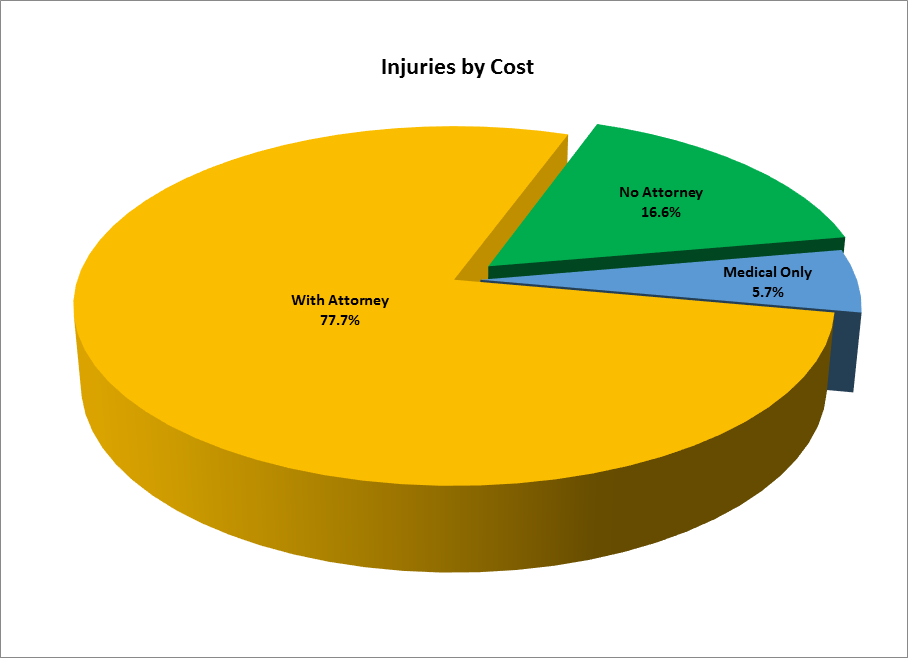
Litigation involves a minority of claims - generally less than 20% in most states. Yet, litigated cases comprise nearly 80% of all claim expenses.

Why, then, does the industry push claims into litigation?

Wednesday, October 28, 2015

Ain't No Justice

I'm probably going to get slammed by injured workers for this post, but that's okay because there's a truth that needs to be said.

There's a reality to workers' compensation that most injured workers who get wrapped up into the system, particularly in litigation, don't appreciate, much less understand:

Workers' compensation has nothing to do with justice.

Nothing.

If you are looking to correct wrongs done to you, or another, via the workers' compensation dispute resolution system, regardless of state or jurisdiction, you're wasting time, money, and your own health.

Here's the bottom line: Workers' compensation is simply a wealth reallocation system. That's all it is.

It was not, and never was intended to, right a wrong, bring people to justice, or provide any sort of revenge.

Justice has no place in workers’ comp. Work comp is only moves money from one pocket to another, with some deductions along the way to pay for that service.

Money comes in from a business in the form of premium. A percent is skimmed right off the top by the procuring broker or agent. Then some is allocated for investment by the insurance or holding company. Some is set aside to pay the cost of claims and the office building and staff. Other amounts are paid to various vendors. At the end of the day there may be some left to return to investors, or to pay employer dividends.


The only reason there’s a dispute resolution process in work comp is because whenever money is involved someone wants more than they are entitled to or what others think they should get, and there has to be a process to manage the dispute and put finality into a transaction.

There’s nothing “fair” about workers’ compensation. Fairness is a legislative matter. 

Legislatures determine what is "fair," and if legislatures go too far out of the "fairness" balance, then a court will intervene. There are state supreme courts reviewing the fairness equation right now, but the standard for review will be the standard espoused by the US Supreme Court in 1917 when America's highest court held compulsory work comp was constitutional.

So long as comp provided a "reasonably just substitute" to a tort claim, the US Supreme Court ruled in New York Central Railroad Co. v. White (1917), then it could be the sole means a worker had for recovering against an employer.

There's a lot of factors going into the determination of "reasonably just substitute" - not just how much money a claimant gets, or the timeliness or thoroughness of medical treatment, etc.

Certainly there are court challenges pending in various states arguing that work comp is no longer fair, that the Grand Bargain has been compromised to such an extent that it doesn't meet the Supreme Court's standard of a "reasonably just substitute," but that's not in the NOW, i.e. the present reality. Any future supreme court ruling about workers' compensation constitutionality won't help the claimant TODAY.

You or I may not make it to tomorrow. We need to deal with today...

As in any wealth reallocation system there are winners and losers. And there is plenty of friction in the system that gets in the way of an injured worker receiving benefits - there's no argument about that. 

Injured workers all too often get the short end of the stick. We have chronicled that many times in this blog and in the news.

But, there was a time not too long ago that the business sector felt they were getting the short end of the stick too, that they weren't being treated fairly and they couldn't get justice either.

Here's the real deal: Employers and their workers are in the same boat - without work to do, there is no employer, nor workers who may get injured. Likewise, without workers, there's no way business can get done.

Each needs the other. Sometimes that relationship is more balanced than at other times.

It’s not intended to be “fair.” It is simply reallocation of wealth - plain and simple. 

Everyone in the workers' compensation industry makes money off the misery of injured workers and their families.

We all profit off the injured worker in some context or other. Some, I’ll certainly agree, push the boundaries of ethics, morality, and legality.

To be clear, I'm not against an injured worker having legal representation. Most systems are complex. The concepts and terms are confusing, unfamiliar, and there are many traps for the unwary.

But a lawyer on your case is not about seeking justice. For the claimant, a lawyer's job is to maximize case value because that's how they get paid. The more the case is worth in terms of dollars, the better the pay day. For the claims payer the lawyer's job is about minimizing the expense.

And there's nothing wrong with that because, as I said, workers' compensation is about wealth reallocation and the injured worker's attorney does the job by reallocating as much as possible within the rules of the game to the injured worker. The defense lawyer checks the balance.

Sometimes wrongs occur in cases, and the lawyer will seek redress for those wrongs - again within the rules of the game. And those rules generally provide for some remuneration to compensate for those wrongs (we call such remuneration, "penalties"). The motive, again, is case value maximization - not to teach a lesson (though sometimes a lesson may in fact be taught).

An injured worker seeking justice through the workers' compensation dispute resolution system jeopardizes health, sanity, and life itself wasting years that could be spent living while trying to buck a system designed as an administrative process.

The bottom line - injured workers should get into and out of workers' compensation as rapidly as possible. Whatever it takes to exit the system with some modicum of health for the future, and whatever indemnity the law provides, is the goal.

Living the claim takes years off a life for naught. Workers' compensation litigation is a terrible place to live.

Wednesday, September 23, 2015

Profit Before People

I wrote yesterday about reality and perception, yet we, the industry, continue to be our own worst enemies creating negative realities to match the negative perceptions.

The industry got a bee in its collective bonnet when ProPublica and OSHA issued reports and stories with anecdotes about how the workers' compensation system failed injured workers.

Countless injured workers who have dared to speak out publicly via forums, blogs, social media, television, radio and other media outlets, are castigated and marginalized by the industry as wacky complainers who don't have a life so they focus on claims.
Poor Bowser...

Industry insiders are afraid to blow the whistle for fear of retribution, or worse.

Attorneys representing injured workers are vilified for taking advantage of the system's alleged "no fault" design to erode the protections afforded employers.

Our own governmental agencies tout statistics reflecting decreased claim frequency and severity, lowered medical costs, but improved outcomes, but anecdotes keep appearing challenging the rosy stats.

But, as we see in Kelly Tinsley vs. Vertis Communications; ACE USA/ESIS, the system is NOT balanced, is greatly skewed against injured workers and without representation people would die, victims of The System.

Tinsley had an admitted industrial injury to his neck, spine, neurogenic bowel, neurogenic bladder, internal organs and psyche employer as a machinist arising out of an incomplete C6 spinal cord injury on January 10, 2010.

After being hospitalized, Tinsley was released home, and started having active suicidal ideations. He began treatment with Dr. David Patterson through the Casa Colina Transitional Living Center Residential Program Post-Acute Physical Rehabilitation with One on One Supervision (whew!)

He attempted suicide on 8/31/2011 by carbon monoxide poisoning. When he failed to show for an appointment a friend checked on him and found him lying on the garage floor. He was airlifted to a hospital, and after three days of inpatient care was released home and thereafter admitted back to Casa Colina on 9/2/2011.

Eventually Tinsley was seen by a Panel Qualified Medical Examiner who opined that Tinsley's active suicidal ideation was real, was a problem, and that he should not be released back to the care of a family member because the suicide hazards could not be managed properly.

The claims adjuster requested that the Requests for Authorization for Casa Colina be submitted one month at a time. Dr. Patterson complied.

According to the Workers' Compensation Judge's report on reconsideration, "There was no conflict or disagreement between the applicant's primary treating physician, Dr. David Patterson and the Panel QME, Dr. Greils as to the reasonableness of the treatment prescribed and provided."

For whatever reason, the claims adjuster (who had been on the case from the outset according to the WCAB opinion) decided to submit the 9/28/2014 RFA to utilization review, without any of Dr. Greil's medical reports, his depositions, or the deposition of Dr. Patterson.

As you might guess, UR denied the treatment, and the claims adjuster stopped paying Casa Colina.

"The court found the failure of ESIS to send the relevant medical reports and depositions to the doctor performing the Utilization Review to be troubling. There are few cases where the issues of life and death are truly before us. This is one of those rare cases. In the 10/7/2014 Utilization Review, Dr. O'Brien refers to the Medical Treatment Utilization Schedule [MTUS] for neck and upper back complaints and treatment for chronic pain. Dr. O'Brien does not address the fact that the basis for the recommended one on one care is due to the opinion of his treating and evaluating physicians that he will kill himself if this care is not provided.
...

"Mr. Tinsley therefore continues to be a resident at Casa Colina although it is represented it was about to discharge him due to non-payment of his treatment provided since October 2014. No doctor has been able to find a better alternative..."

When ESIS stopped payting Casa Colina, treatment was paid through Tinsley's own funds.

The issue that really brought this case to the WCJ was not the egregious behavior of the claims adjuster and ESIS, but that they couldn't even follow The Law with respect to service and timeliness.

Listen, the law and regulations are SO stacked in favor of the payer community right now, a failure in procedure is inexcusable. If you can't get it right, then don't try...

"The WCJ correctly found that the UR was invalid because defendant did not show that it was timely communicated to Dr. Patterson...," the Board wrote. "The WCJ also properly relied upon the holding in Dubon II to award the treatment at issue because it s reasonable and supported by substantial medical evidence."

The failure in compassion and humanity in this case is beyond inexcusable and, frankly, nearly criminal.

The Board chastised ESIS and the claims adjuster for not even being able to follow procedures (procedures that were fomented mostly by the defense community in recent reforms) and then still trying to claim a defense against DOING THE RIGHT THING.
In a separate concurrence, Commissioner Sweeney hit upon the real issue: "However, it is important to note that there is no evidence in the record of any change in applicant's condition or circumstance that reasonably supports the initiation of UR to evaluate the ongoing treatment as (sic) Casa Colina that had been routinely approved and successfully provided for several years."

And, had the case been Commisioner Sweeney's to adjudge herself, she would have thrown the proverbial book at the defendants, "In this case, there is no evidence that defendant made any effort to reach an agreement on a care plan with applicant's treating physician before it terminated payments to Casa Colina. The absence of an agreed care plan to address the consequences of discontinuing inpatient care at Casa Colina as part of the UR could be considered a neglect or refusal to provide reasonable medical treatment [citations]."

Perception derived from reality: too often it seems the claims community would rather an injured worker DIE instead of paying for a lifetime of treatment because it is cheaper - the mighty dollar is, indeed, more important than human life in Corporate America.

The only logical conclusion I can draw is that the payer would rather Tinsley kill himself instead of having to deal with this claim, and its expense (reportedly $40,000 per month), for the rest of his, frankly, miserable life.

Does work comp have a bad image? You bet. This case demonstrates why. And frankly that image is deserved when this kind of behavior occurs.

I hope applicant's attorney takes the defendants to the cleaners on this case, and moreover, I hope that the emasculated Audit Unit imposes the harshest of the now castrated penalties on the payer.

Not that it will teach anyone a lesson.

You know why this world needs lawyers? Because there are still way too many who put profit before people.

My team at WorkCompCentral work really hard to highlight the good in workers' compensation.

Cases like this make communicating that message difficult.

A copy of the Opinion and Order Denying Defendant's Petition for Reconsideration is here.

*************

Post script from the applicant's attorney, Keith More:

Awesome - thank you for  understanding the plight of the injured worker. Timeliness,  REALLY !!!  That is the only way I could get this to the Judge. Not the simple fact that the Labor Code and Rules and Regs REQUIRES the appropriate medical records be reviewed by a UR physician within the same specialty or area of practice. This is why Dubon II must be overturned. The WCAB found it "troubling" that the PQME report was not submitted for review or why the 2 volumes of the PQME's depositions were not sent by the adjuster for review, What about the FACT that the UR doctor chosen by Ace/Esis this time, was an internist who does not have an outside office and does not see patients for treatment purposes. Mr. Tinsley did not have an internal issue. Why and how could anyone in compliance with the law choose an INTERNIST for this review. It's not like the adjuster had not seen this request 28 days before. It's not like the adjuster did not see the same request 28 days before that. None of the other requests had been sent to an INTERNIST. 

The request for medical care was not for chronic pain (the basis for the denial). Troubling is the best they, the WCAB could do since they overturned Dubon I. It's not troubling it's alarming. It's abusive. It's punitive. This system is called "Worker's Compensation" not "Insurance Profits"! Ace/Esis through its adjuster Cheryl Brownlee who we personally served to appear at trial has already told Casa Colina they will appeal the Decision. 


Why not? Well, the WCAB while using strong language failed to issue sanctions on its own for the "troubling" behavior. "Every life is worth saving", a brave firefighter said after 9/11. Why not Kelly Tinsley, a 27 year dedicated employee of Vertis who was severely injured on the job.  

Wednesday, August 26, 2015

Fly The Claim

Four One Mike over the LA basin managing risk...
Heading back to California today from the 70th annual WCI Educational Conference in Florida, it's been a week since Bonanza Six Six Four One Mike has been in the air and it's been 8 days since I checked up on Mom.

Last week Mom was still dealing with a bit of pneumonia in the lower left lobe of her lung. She was happy as she normally is, and even referred to me accurately as her son (normally she gets this confused and I've been called grandson, nephew, husband, cousin ... everything but her son).

But Mom still had a bit of a cough, and still required oxygen because her O2 uptake without the supplement was in the low 80s.

My brother had stopped by a few days ago to install new safety cords to her hearing aids because the original installation had broken. He reported an otherwise "normal" Mom.

And of course, Four One Mike hasn't been in the air since then. I know she'll need a half quart of oil before I fire up that Continental IO 520 tomorrow; she may need some air in the tires, and the windshield will need a good cleaning. The GPS database needs its 28 day cycle update.

Otherwise I don't expect any surprises from Four One Mike - the pitch servo is still in Kansas for repair but once properly trimmed the plane flies hands off just fine and the pitch servo is only missed when doing an instrument approach (without a pitch servo there is no autopilot coupling to the vertical gradient, so it must be hand flown).

A couple of days ago the airport manager at Oceanside called and left a message that the left rear window was still open (doh!), but that there didn't appear to be anything amiss with the car I use to visit Mom after landing ... phew!

Here it is, well more than 24 hours in advance and I'm already thinking of what needs to be done to accomplish the mission of checking on Mom.

In our world, we would call this a part of risk management.

Risk management entails thinking ahead and making sure that contingencies are in place to deal with the unexpected. Certainly tomorrow things could go wrong. Part of this phase of risk management, however, is planning.

Planning is a primary and critical risk management technique. It is the basis of risk management.

Risk management isn't rocket science. Hell, it's barely science at all - it's mostly common sense. We have thousands of years of existence on this planet and there's not a whole lot of risk that hasn't yet been experienced by human beings.

The lessons we have learned over those thousands of years have been reinforced by experience. We have documented and chronicled the unexpected. We have studied those events. We have devised methods of minimizing such events in the future, and have strategies for dealing with them in case similar events do occur.

Risk management is, by definition, a conservative practice. It has to be because you can't manage the unknown; one doesn't experiment with risk.

Which is why I cringe when I see phrases touting, "Cutting edge risk management techniques."

That phrase is an oxymoron. There is nothing "cutting edge" about risk management. Being "cutting edge" strongly implies operating outside the norm, on the fringes of what is known and established.

Workers' compensation has no place for "cutting edge." We live in a very basic, fundamental world. Work place safety essentially means don't be stupid, and prevent other people from being stupid, or at least minimizing the possibility that someone will be stupid.

Flying epitomizes risk management, and trust me, there's nothing "cutting edge" about making sure planes don't fall out of the sky or hit things that break them.

The lessons have been learned and repeated, and get repeated thousands of times every day: planning, communication, decision making.

Fail any of those three fundamental risk management techniques in aviation and ... you die.

It's a pretty simple concept.

Pilots and airplane owners can make things complicated. We can get tangled up about operational details: manifold pressure readings at certain altitudes, propeller RPM, indicated airspeed versus angle of attack, comm one or comm two, ATIS reports, TCAD settings, frequencies, approach plates, departure procedures, etc., etc.

Lots of details.

But when something bad happens pilots revert to basic, fundamental risk management techniques and the single most basic those is, "fly the airplane."

"Fly the airplane." Simple, concise, easy to remember ... which is what humans need when panic sets in.

We panic a lot in workers' compensation. We talk about medical marijuana, opt out, reform, fee schedules, waiting periods, and other topics that induce industry anxiety.

We get all confused about "flying the airplane" in workers' compensation. We get hung up on the operational details: TTD, PTD, RTW, ACOEM, ODG, MTUS, MPN, QME, etc., etc.

Ugh ....

There's lots of "cutting edge" risk management techniques propounded by "experts" who sell products and services to keep the industry "cutting edge."

The reality is that all these cutting edge risk management techniques just increase costs because it takes away from just "flying the airplane," or in the case of workers' compensation, just paying the claim.

I know, I know - it's not that simple. There are rules to abide by, hoops to jump through, things to be audited, checks and balances ... all sorts of details to pay attention to.

I suggest that it IS that simple; that it doesn't have to be that hard. Is there an injury - yes or no? Does that injury require treatment - yes or no?

When a pilot "just flies the airplane" he or she makes binary decisions - yes or no. There's no time to consider whether the FAA might get mad or ATC might have an issue. There's no time to fiddle with gadgets, dials and knobs.

Everything is a yes or a no, broken down to the most simple, basic risk management fundamentals.

Tomorrow, I'll check flight conditions. My pre-planning today suggests that everything should be fine and within the capabilities of Four One Mike and its pilot.

I'm planning to fly Four One Mike. I'll check the weather and decide, yes or no, whether to go. I'll preflight the plane and then make a yes or no "go" decision.

I'm planning on seeing you tomorrow Mom! I'm hoping for a "yes" risk management decision, but hope you're not disappointed if it's a "no."

Thursday, July 16, 2015

Simply Complex

California workers' compensation claims stay open longer, much longer, than the national average and as a consequence cost a whole lot more when compared to other states, and according to the Workers' Compensation Insurance Rating Bureau much of this has to do with when medical treatment is paid for.

Only 39% of ultimate accident year medical payments in California are made within the first 36 months of an injury, compared to a national average of 67%.

As a consequence, California employers pay more for workers' compensation insurance than any other state no matter what study is used to compare statistics.

The WCIRB analyzed 1 million claims and $4.4 billion in medical benefit payments. The claims were divided into categories based on the interval between the date of the accident and the date of medical service.

Of the claims reviewed, 84% had medical services provided within the first three years following the accident. These claims accounted for 66% of total medical payments reviewed.

About 12% of claims had medical services being provided between three to 10 years from the date of injury, accounting for $970 million, or 22% of payments reviewed. And while only 4% of claims were still getting medical services between 10 and 30 years after an injury, payments for these claims totaled $559 million, or 13% of costs.

Greg Johnson, director of medical analytics for the WCIRB, said in a WCIRB Research Forum webinar yesterday that claims start to develop similar patterns the longer they stay open: Prescriptions for narcotic painkillers and psychoactive drugs increase for workers still receiving medical care three years following an injury.

Prescription drugs account for 10% of payments made for services provided up to three years following an accident. That number increases to 27% of payments services provided three to 10 years following an injury and 37.2% of payments 10 to 30 years after the accident.

Johnson noted that the amount spent on drugs is about 4% to 5% higher than the amount paid to pharmacies for each cohort, and that physician dispensing is the culprit, and that the longer a claim stays open the more likely narcotic prescriptions become involved.

Johnson couldn't say whether there was a cause and effect in the relationship, only that we know there is a relationship.

In addition, three years after an injury payments for services such as physical therapy and chiropractic care drop off considerably, which makes sense given California's hard cap and reimbursement restrictions on those service codes.

Physical medicine accounts for 11.1% of payments for services up to three years following an injury, 4.2% of payments for services provided three to 10 years after an injury and 2.2% of payments 10 to 30 years after an injury.

Of course those conditions evolve from acute to chronic in nature, further complicating the treatment picture.

"This shows me we've got an aging population," Johnson said. "If you look at the health care statistics in the population, these chronic problems obviously develop with other people, and the comp system is paying for many medical problems of aging. The acute injuries are related to the original injury, but the individuals here evolve in terms of the primary diagnosis to more chronic problems over time."

I'm sure there's all sorts of other explanations as well, and everyone can point a finger at someone else for this phenomenon.

All that doesn't matter. Everyone's to blame and no one does anything about it.

The fact of the matter is that behavior of everyone in the system is a product of the laws and regulations that establish the boundaries. Those boundaries drive incentives. Incentives drive behavior. Behavior drives costs.

I wrote on Tuesday about trust. There is very little trust in workers' compensation. There's even less trust in California.

That's why we have artificial limitations on physical medicine services - because there was a group of providers who couldn't be trusted.

That's why we have fee schedules for copy and interpreting services - because there was a group of vendors who couldn't be trusted.

That's why there's a claims audit process and a penalty system - because there was a group of claims payers who couldn't be trusted.

That's why there's payroll audit and employer premises inspections - because there was a group of employers who couldn't be trusted.

That's why there's sub rosa investigation and prying into the private lives of injured workers - because there was a group of employees who couldn't be trusted.

With each level of mistrust there's greater gesticulation by the conductor, and all of us react in amplified manners to the point where the entire "orchestra" is flailing and creating the comedy that gets ridiculed and despised.

If you look at the top performers in the self-insured/administered category you don't find these statistical anomalies, and claims get closed faster, employees return to work and have less disabilities - because the employers trust their providers and their employees, and the providers trust the employers and the employees, and the employees trust their employers and providers.

It's a complex trusting relationship that takes a lot of work to establish and maintain and frankly it comes down to money.

The friction in the system is money. But the lubrication in the system is also money. There's a fine line between the two. That distinction is understood by those top performers and they use those incentives to drive their claims cultures.

Those with good experiences look at the moon, not at the finger pointing at the moon. They pay for good results up front, not for bad results at the end.

It's really quite simple, yet unnervingly complex.

Monday, May 4, 2015

Finger At The Moon


The Workers' Compensation Research Institute out of Boston, MA, last week released another of its CompScope Benchmarks reports (requires purchase), focusing on California.

There's lots of data and information about the cost of California's system, comparing it to other benchmark states (the others being Arkansas, Florida, Georgia, Illinois, Indiana, Iowa, Louisiana, Massachusetts, Michigan, Minnesota, New Jersey, North Carolina, Pennsylvania, Texas, Virginia and Wisconsin) and if you're an analyst or other work comp wonk, the numbers are interesting.

For instance, California experienced a 5% decrease in medical payments per claim during 2013 and 2014, post SB 863.

And California logged a larger share of claims with more than seven days of lost time than most of the other states – 28% – and reported average indemnity benefits per claim of $19,422 – 10% higher than the $17,670 median reported for the 17 states in the study.

Average benefit delivery expenses per claim in California, at $8,957, was 71% more than the median for the study. California also reported a larger share of claims with medical-legal expenses than other study states at 27.2%.

David Bellusci, executive vice president and chief actuary for the California Workers' Compensation Insurance Rating Bureau, told WorkCompCentral that while these costs are going down, "we're not seeing the frictional costs go out of the system."

The California Applicants' Attorneys Association said those frictional costs are being used to deny care, rather than control expenses.

"UR and IMR are being used to bring down costs, but not improve health care and certainly not to provide care in a timely manner," CAAA President Bernardo de la Torre said in a statement to WorkCompCentral.

This is all good for debate within the industry, but this debate about costs, expenses, friction, etc. misses the salient point and misdirects the conversation: the reason for frictional costs is because the claims decision making process, in my opinion, now has too many cooks in the kitchen.

Claims adjusters defer to utilization review, defer to bill review, defer to this, that and the other.

Communication with the injured worker is hampered by state regulatory requirements of mandatory language and procedures, which are very bureaucratic and, frankly, scary much of the time - driving attorney involvement, and once an injured worker consults an attorney that attorney gets hired...

Relations with medical providers has deteriorated to the point where the physicians that are still accepting workers' compensation patients do so under huge volume pressures; treatment hardly involves any "bed" time, which studies have shown to be hugely therapeutic, but does correspond with more pill pushing.

Employers remain largely apathetic to the claims administration process, relying on the "expertise" of professionals without understanding that they have a say in the claim and, consequently, a voice in how their experience rating is affected.

There's plenty more friction to go around, and as I have said before, it is our own doing, and up to us as team members that may have disparate interests to work together to reduce that friction.

Otherwise we truly do risk the demise of an otherwise beneficial system and important economic tool.

So we can look at all the costs and expenses and determine what to trim, but this is looking at the finger pointing at the moon, rather than the moon.

"Emotional content, not anger. Don't think ... feel. It is like a finger pointing away to the moon. Don't concentrate on the finger or you will miss all that heavenly glory." Bruce Lee, Enter the Dragon.

We too often engage in workers' compensation with anger. We think, and don't feel, and miss the heavenly glory.

It's not about costs and expenses, it's about taking care of the claim.

Thursday, November 20, 2014

Serendipitous Repetition

Serendipity seems to follow me.

I was, of course, at the National Workers' Compensation and Disability Conference at the Mandalay in Vegas last night, attending a cocktail party, and became engaged with a Certified Shorthand Reporter, aka court reporter to those who don't wander the Halls of Justice.

I don't recall which jurisdiction she was from, but we were talking about how CSRs were going out of favor, sometimes being replaced by technology and sometimes not being replaced at all.

I was in hyperactive mode, and rambled something largely unintelligible to her. She wistfully replied, "say again counsel."

And that put us into a discussion about how, in certain circumstances, technology can not replace a human doing the job of a CSR - because a machine can not stop the person whose speech is unintelligible and request a restatement, and then certify to others that what is transcribed onto paper is what was actually said.

In her jurisdiction the courts no longer provide a CSR at taxpayer expense, so counsel must hire their own out of pocket and hopefully recoup that cost later in the case. Sometimes the opposing parties will agree to share the cost of a CSR because if there's any anticipation of appeal a certified transcription of testimony will be necessary for a complete record going up to the appellate court.

Then I wake up this morning, and the top headline in WorkCompCentral News is "Supreme Court: WCC Must Provide Stenographers for All Hearings."

Whoa! Did I really have THAT much to drink last night? Or was someone eavesdropping?

Turns out that yesterday the Oklahoma state Supreme Court released an opinion that the Workers’ Compensation Commission will be required to provide a stenographer for all of its hearings.

The 7-2 decision came after attorneys filed an application for original jurisdiction with the high court on behalf of six claimants who were denied commission-provided court reporters for their case hearings.
Guaranteed by the OK Sup. Crt.

Supreme Court Chief Justice Tom J. Colbert took authorship of the one-paragraph decision, assuming original jurisdiction of the case and directing the commission to provide a stenographer for all hearings before the commission.

As you likely are aware, the state went through a bit of trauma last year when legislators overhauled the workers' compensation system, including its administrative dispute resolution process, and also implementing a form of "non-subscription" to better compete with neighboring Texas.

As part of that reform, a new Workers’ Compensation Commission was created to handle hearings for claims of injuries on or after February 1, with the Court of Existing Claims handling legacy claims.

The WCC rushed to implement emergency rules to accommodate the deadline and part of those rules provided that the commission is required to make an audio recording of all hearings before the commission or administrative law judges. The commission is also required to provide those recordings on digital media to any requesting party at no charge.

But a court-reported transcript would be made “at the request and expense of the person ordering it, or at the request of the Commission, in which case, a copy will be made for any person requesting it, at that person’s expense.”

That WCC's rule, found in Title 810:10-5-48(d), conflicts with Title 85A-72(B) in the state’s Workers’ Compensation Act, which just states that all commission hearings “shall be open to the public and shall be stenographically reported.”

“To the extent that Emergency Rule 810:10-5-48(d) conflicts with the requirements” of the workers’ compensation statute, Colbert wrote, “the Commission is prohibited from providing only an audio recording of all hearings, in lieu of a stenographer.”

“Because we have many workers in Oklahoma that don’t speak flawless English,” one of the attorneys who petitioned the Supreme Court, Bob Burke, told WorkCompCentral. “So an oral recording would not work on appeal. Because with a court reporter sitting there, if they don’t understand that word, they can literally say, ‘Sir, could you repeat that,’ or ‘How do you spell that?’”

So there you have it - another serendipitous moment comes to life.

"Could you repeat that please?"

Thursday, November 13, 2014

Oh! To Be An Attorney!

Florida’s Office of the Judges of Compensation Claims will release its report to the state legislature in a few days as required by law. Chief Judge David Langham had primed the pump, so to speak, by blogging about initial findings on attorney fees in the state.

After his first report he discovered anomalies in the data which led him to investigate, and eventually correct the error. One of the reporting third party administrators had been using an incorrect query and consequently had erroneously inflated defense attorney expenditures by a few million dollars.

The corrected numbers are posted now on Judge Langham's blog.

The corrected numbers reflect that attorneys in Florida for fiscal 2012-13 were paid a combined total of $382 million; claimant attorneys got $142 million and defense attorneys about $240 million.

The total amount of fees being paid attorneys has been on the decline in the state since SB 50 had passed severely restricting claimant fees, and the assumption from participants in the system is that had a similar effect on defense fees.

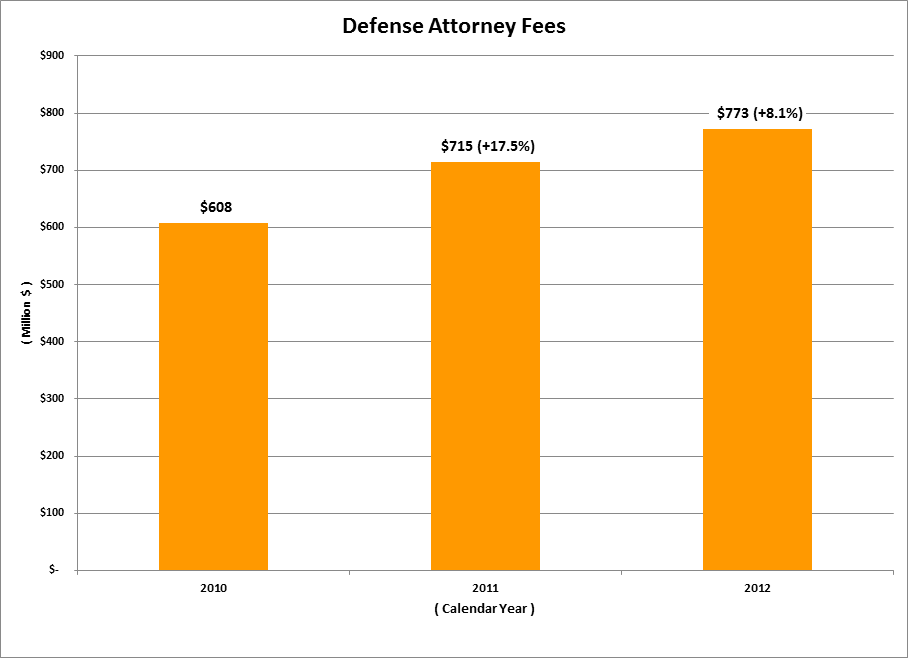
In contrast, the California Workers' Compensation Insurance Rating Bureau last reported gross total attorney fees in California for 2012 was about $1.223 billion. Applicant attorneys got $450 million of that gross, and the defense was paid about $773 million.

Fees in California have been growing at about 8 % per year since just a couple years after Schwarzenegger's SB 899 sharply curtailed the benefits upon which most applicant attorney fees are based.
image002.png
Indemnity claims in CA with an attorney are 78% of all claim costs. 

I was curious about how California stacked up against Florida - both states are known for being particularly litigious in workers' compensation.

A walk around the exhibit floor at the annual Workers' Compensation Institutes conference in August impresses one with all of the defense firm exhibits (and parties).

California lawyers on the other hand each have their own conferences, and even still defense firms will exhibit at some of the other employer or carrier based conferences in the state.
image003.png
In contrast to FL, CA defense fees have continued to grow.

So while this is not a scientific study, and in fact I'm not even comparing apples to apples because the dates of the data collection are different, and there are other serious issues with this analysis that any competent high school statistician could tear apart, it is interesting nevertheless in terms of seeing where a big part of the money goes.

One comparison is just how big of a market are we really talking about.

For instance, California's gross written premium for 2013 according to the WCIRB was about $14.8 billion; the national gross written premium according to the National Council on Compensation Insurance was about $41.9 billion (includes state funds and private carriers).

So California represents about 35% of the total gross written premium of the entire nation.

According to NCCI's last report Florida's total gross written premium for 2013 is $3.21 billion, or 7.7% of national gross.

If we compare attorney fees as reported above to gross written premium, then for every premium dollar collected in California, twelve cents went to attorneys.

In Florida that ratio is 8.4 cents; a difference of about 30%. In other words, if you're going to be a lawyer in workers' compensation, California is about thirty percent more lucrative than Florida.

If we compare how much goes to defense representation as opposed to injured worker representation, the ratio is very close.

In California the ratio is 1.72. In other words for every applicant attorney dollar the defense spent a dollar and seventy two cents.

In Florida the ratio is 1.69; a very similar ratio.

Defense attorneys will defend (pun intended) their fees because work comp is "long tail" so they are working on cases that may be years old, or that they need to deal with issues that claimants don't such as resolving unsettled medical expenses.

Whatever - the point is that there is a lot of work available for attorneys, particularly defense attorneys, in workers' compensation. Just look at WorkCompCentral's job ads!

Sometimes I wonder if I should have stayed the course and remained a defense attorney instead of founding WorkCompCentral.

Nah....

Tuesday, November 11, 2014

Vultures At Both Ends

Yesterday I espoused about our industry penchant to make a very simple proposition much more complex and difficult than necessary. We introduce all sorts of officious intermeddlers into the system and, I believe, that when we really get down to it anything that wrong with workers' compensation is our own doing.

Even on this own blog you are likely to run into advertisements like this one:
Would you click this ad?

Clicking on this ad will take your browser to http://workers-compensation-law.us where you will find "Free Workers' Compensation Help - Get your FREE, no-obligation evaluation today and find out how much your claim is worth."

This is obviously an attorney referral service, and frankly is probably against state bar rules in many states - but how can that be regulated effectively over the Internet and across the nation?

The website says that when you submit your information you are going to be contacted, and not necessarily by an attorney, but probably by a slick telephone sales person that will prey upon your work injury weakness and ensure that you are directed to one of their referral clients:

"By submitting your request, you grant permission for up to two of our premier partners to contact you using the phone number or email address that you have provided so we may assist you with your request for a free case evaluation and potentially an offer of representation and services. You agree that the matched partner may use an automatic telephone dialing system even if the number you provided is a wireless phone number. You understand that consent to being contacted is not a condition of purchase or acceptance of services of any kind."

Click around and you are taught that it's probably a good thing to get an attorney through this referral system:

"By law, you have the right to represent your own interests when filing a workers' compensation claim. You are not required to hire an attorney. However, because the process of filing a workers' compensation claim can be complex, many injured workers hire a legal professional or an attorney to advocate on their behalf. This is to ensure that they receive the maximum amount of compensation for which they are eligible."

The advertisement play hard on the adversarial nature of employer versus employee, I'm sure hooking every injured worker out for revenge:

"If you are an injured worker that has always worked hard for his or her employer, it may be difficult to accept that you can no longer work in the same capacity as you once did. Moreover, you may also have personal issues with receiving the assistance you need to sustain yourself. An attorney or legal professional can help to ease the burden and stress of dealing with the complex and bureaucratic process of receiving compensation. Furthermore, dealing with the complexities of the workers' compensation process as well as the emotional and physical strain of a debilitating injury is overwhelming for most people. An attorney advocates for you and eases many of the legal and emotional hassles so you can focus on recovery or rehabilitation.

"Insurance companies and state agencies are focused on giving you the smallest amount possible for your injury. They are professionals and deal with this system on a daily basis. Their experience and knowledge of the system is a tremendous asset in contested or difficult claims.

"If you are injured you deserve the maximum amount allowable in order to take care of yourself and your loved ones. A competent experienced attorney or legal professional will ensure that your claim receives the benefits you deserve."

The salacious solicitation goes on and on with predatory appeal to emotions surrounding entitlement mentality, insecurity, retribution and vengeance, and of course just plain greed.

BUT IS THAT ANY WORSE THAN THIS?

From a recent post on the WCC forums:

"I have found at least one major CA UR company is limiting 50 pages of medical documents allowed when appealing a UR denial. If more than 50 pages are sent, they call the claims adjuster and ask for approval to review more records. If the claims adjuster says no, then they stop reviewing records at page 50. There is nothing in the states rules and regulations that state such a limit. I did ask if they notify the person who sent the records, either the doctor, attorney or injured worker when they do not review all of the records. The answer I got from a UR supervisor was "no, the claims adjuster is our customer and we have to do what he says, if he does not want us to review more records or does not want us to review certain records we do not". I was advised to ask the claims adjuster about this as they only do what he states they can do."

ARE YOU KIDDING ME?

So let's drive the claimants to attorneys with nonsense like this. Limiting the quantity of records that are sent to utilization review is, in my mind, not only against the Labor Code and regulations concerning UR, but is both a sanctionable event via hearing before the Workers' Compensation Board (I know, claims LAUGH at penalty attempts now a days since they were essentially eviscerated by SB 899) and California Audit Unit (which as we have seen in prior posts is laughably meek as well).

It seems to me that this claims directive of randomly limiting the number of pages of records to 50 in order to save a couple scheckles is practicing medicine without a license. It's also behavior that intentionally deprives an injured worker of a fair review even if the UR company isn't also owned by the claims house or getting kickbacks, or some other nefarious financial interrelationship that is of questionable ethics.

“Analytics can give you a sense of which types of claims result in litigation, how much it can cost and can perhaps tell you how to alter the claim management so, again, there is less likelihood of it resulting in litigation,” Robert Hartwig of the Insurance Information Institute said in a story this morning in WorkCompCentral News.

Guess what folks, you don't need analytics. You just have to look at examples like the one above to understand what needs "alteration."

I've said it before and I'll say it again, and again, and again ...

THERE'S NOTHING BROKEN ABOUT WORKERS' COMPENSATION!!!

The only problem the system has is YOU.

Feed the system crap and you get crap.

Thursday, September 4, 2014

Plead It Correctly

Just in time for the Insurance Council of Texas' annual workers' compensation conference in a couple weeks, a Texas appellate court reversed a bad faith jury verdict of nearly a half million dollars, which should provide some topical discussion material for presenters.

In the famous Ruttiger case, the Texas Supreme Court ruled that a 1989 overhaul of the state Workers' Compensation Act had eliminated causes of action for the breach of workers' compensation carriers' common-law duty of good faith and fair dealing when adjusting claims.

The court did say, though, that the amended act “does not purport to preclude all types of claims against workers’ compensation insurers,” and that Insurance Code Section 541.061 would continue to apply to carriers.

That code section provides that it is an unfair or deceptive trade practice for a carrier to misrepresent an insurance policy by making an untrue statement of fact or misstatement of law.

On Friday, the Court of Appeals for the state's 5th District last week said that Jeff Palmer could take nothing on his claim after a jury awarded him $483,716.69 against Texas Mutual, because he had failed to include a plea of an alleged violation of Insurance Code Section 541.061 in his amended petition for relief.

Palmer claimed a January 2006 back injury from using a jackhammer to break concrete. Doctors determined that he had a slipped disc in his back, with some nerve impingement.

Texas Mutual initially accepted Palmer's injury as compensable and began paying him temporary income and medical benefits.

In February 2006, Palmer's doctor requested authorization to perform an L4-5 and L5-S1 laminectomy and discectomy. Texas Mutual granted approval for the procedure on the same day it filed a dispute over the extent of Palmer's injuries with the Division of Workers’ Compensation.
Bowzer's back pain a procedural morass.

For the next several months, the parties haggled over whether Texas Mutual was obligated to pay for the surgery it had authorized, in light of its contest to the compensability of the condition the surgery was supposed to address. Palmer's doctor refused to do the surgery until the parties resolved this dispute.

Palmer finally got his surgery in July 2006, and Texas Mutual paid for it, as well as for his post-surgical care, physical therapy and pain management. Once Palmer reached maximum medical improvement, Texas Mutual paid him benefits of $267.25 per week for 15 weeks.

After the payments ended, Palmer filed suit against Texas Mutual in July 2007. In his initial complaint, Palmer accused the carrier of violating its common-law duty of good faith and fair dealing, unspecified provisions of the Insurance Code and the Texas Deceptive Trade Practices Act.

He blamed Texas Mutual's "brazen and dilatory blockage" of his surgery as the reason he had to endure months of pain, and he asserted that the prolonged impingement on the nerves in his spine had led to his development of left thigh and calf atrophy.

Texas Mutual filed special exceptions to Palmer's complaint, asserting that his claims under the Insurance Code should be stricken pursuant to the Supreme Court's decision in Ruttiger.

It supported its motion with citation to language from the Ruttiger decision holding that a dispute about whether a worker’s claim was covered under workers’ compensation will not constitute a misrepresentation under Section 541.061.

Dallas District Judge Kenneth Molberg struck Palmer's Insurance Code claims. Palmer amended his petition to plead only a breach of the common-law duty of good faith and fair dealing and unconscionable acts under the Deceptive Trade Practices Act.

The case then proceeded to trial, and Texas Mutual moved for a directed verdict in its favor.

Molberg denied the motion, saying he found Texas Mutual’s actions to be "absolutely incomprehensible." He chided the carrier for having engaged in "one of the most outrageous, egregious administrations of a claim that I've ever seen."

Later, despite his earlier ruling striking Palmer's Insurance Code-based claims, Molberg agreed to instruct the jury as to Section 541.060.

Texas Mutual objected, but Molberg overruled the carrier.

The jury then returned a verdict finding Texas Mutual had made a misrepresentation as to the availability of coverage for Palmer's back surgery by authorizing it while simultaneously disputing its liability. The jury awarded Palmer $483,716.69 in damages.

Texas Mutual appealed and on Friday, the 5th District Court of Appeals agreed with the carrier's procedural argument, finding an abuse of discretion by Molberg.

The case troubles me on a couple of fronts.

First, I don't understand why the carrier first approved, very quickly and expediently I might add, surgical treatment, and then delay, deny and otherwise welch on that deal. The carrier's behavior clearly exacerbated the situation.

Who made that decision? Why? And what was the purpose, other than to save carrier money that should otherwise have gone to providing the originally APPROVED treatment?

Frankly, Texas Mutual deserved to be sued. They brought the lawsuit upon themselves.

Second, was Palmer setting up Texas Mutual? I understand that the delay of several months was probably a painful several months, but back surgery is painful in itself for up to a year or more - and the nerve impingement leading to atrophy may actually have been a product of the treatment itself rather than the original injury.

Did Palmer expect to take on the carrier in civil court at the start? Was the intent to get better, or get money?

To be blunt, the 5th District was not only procedurally correct, but the trial judge, Molberg, appeared to have stepped outside his role of independent jurist by resuscitating Palmer's pleading failure.

The full story with links to the 5th District's opinion and the parties' briefs is on WorkCompCentral.

Tuesday, August 12, 2014

Employee? Not Employee?

The employment relationship is often defined by timing, and sometimes influenced by the potential dispute resolution forum. A recent Pennsylvania case is illustrative.

Paul Marazas worked for Vitas Healthcare Corp. in Pennsylvania.

After spending a weekend on call, Marazas reported to work and received his daily itinerary. His assigned route for the day included stops in New Jersey, Delaware and Pennsylvania, and was likely to take him until midnight to complete.

Marazas went to his manager's office and asked to have his schedule adjusted because he was still tired after his weekend on call. When his manager refused his request, Marazas stated that he could not continue to work under such conditions and quit.

His manager then told him that he needed to remove his personal belongings from the Vitas truck. Marazas did so, accompanied by his manager. After he had retrieved his effects and began walking back to the Vitas warehouse, Marazas tripped over a pallet jack.

His manager was with him at the time of his accident and saw him fall. She then walked with Marazas to his car, and he drove away.

A few days later, Marazas called Vitas and requested a referral to physician for treatment of his injuries from his fall. Vitas informed him that it only made referrals for its active employees.
Ouch - didn't see that pallet jack on my way out...
Marazas later filed a civil suit against Vitas in the Delaware County Court of Common Pleas, seeking damages for his injuries. He asserted that he had been a business invitee of Vitas at the time of his accident. Vitas countered that he was an employee and in the course of his employment when he fell.

Marazas then withdrew his civil suit and filed a workers' compensation claim petition for his injuries.

A workers' compensation judge found Marazas and his doctors to be credible, and she awarded Marazas benefits from Nov. 7, 2005 through July 9, 2008.

Vitas appealed, arguing that since Marazas had admittedly quit before he fell the accident was outside the scope of the workers' compensation scheme.

The Workers Compensation Appeal Board agreed and vacated the WCJ's award.

On remand, the WCJ again found Marazas had been within the scope of his employment when he fell because Marazas was furthering the interests of his employer at the time of his accident since the retrieval of his personal belongings that his manager had instructed him to perform was a task at the request of the employer.

The judge once more issued Marazas an award of benefits, and Vitas again appealed. The WCAB once again sided with Vitas, finding Marazas' injuries were not compensable.

On appeal to the Commonwealth Court, however, Vitas lost.

The Court said that while it was undisputed that Marazas had announced his decision to end his employment before his accident, this didn't mean that the scope of his employment had ended.

The WCJ had found Marazas was acting pursuant to his manager's directive in retrieving his belongings from the company truck, and he was under his manager's supervision while doing so, ergo Marazas was still under his employer's control when his accident occurred.

Still the case leaves a bad taste the employer first sought to avoid work comp liability until it realized that civil liability could be worse, and then tries again to deny work comp liability.

Seems there was some bad blood between employee and employer.

And though the Court said that judicial estoppel, which means that a party to a case can not in a different jurisdiction argue the opposite, is a bar only if the party has persuaded a judge that the prior position was correct. Since Vitas had obtained no adjudication that Marazas was its employee before Marazas withdrew his civil suit, nothing was stopping Vitas from changing its argument in defense of the workers' compensation claim.

Commentators on the opinion disagreed with the Court's reasoning on estoppel, but the result is the same: employee and employer don't have a good relationship and it spills into a dispute resolution mechanism - in this case both civil and work comp forums.

And while work comp for most employers gets distasteful, potential civil liability tastes worse.

The case is Marazas v. WCAB (Vitas Healthcare), No. 337 C.D. 2014.

Wednesday, July 30, 2014

The Motel 6 of Justice

Jose Nunez worked as a laborer and driver for Dig Right In Landscaping in Illinois. He claimed that he injured his right shoulder while loading a piece of equipment onto a truck at work in July 2008.

Nunez did not lose any time from work as a result of his injury.

About a month later, Nunez cut his left hand in a work-related accident. He received treatment for this injury from Dr. Hasan Kahn. Dr. Kahn's treatment records contain no mention of shoulder pain complaints or the alleged July 2008 accident.

Dig Right terminated Nunez for cause in September 2008 after learning he was using company equipment to perform "side jobs."

When Dig Right fired him, Nunez made no requests for medical treatment or disability benefits related to his right shoulder.

In March 2009, Nunez sought treatment for right shoulder pain at St. Anthony's hospital. He reported that he had fallen about six months prior, in September 2008. The hospital referred him to an orthopedic surgeon, but Nunez never followed up.

In July 2009, Nunez filed an application for adjustment of claim regarding his alleged July 2008 (or was it September of 2008 ...) injury. His doctor reported that he had a right shoulder impingement. The doctor recommended right shoulder arthroscopy, subacromial decompression and debridement.
"We'll leave the lights on for you..."
Something obviously smelled fishy about this claim and that odiferous feeling didn't escape the trial level arbitrator who found that Nunez's shoulder problems were not causally-related to his July 2008 accident.

The Illinois Workers' Compensation Commission reversed, but a circuit court judge set aside the commission's decision and reinstated the decision of the arbitrator.

On further appeal the Appellate Court ruled that the Commission's award of benefits was not against the manifest weight of the evidence, conceding however that it was "a close case."

It is the exclusive function of the Commission to judge credibility and assign weight to medical opinion testimony, the court said, and the trial judge had erred in setting aside the Commission's award to Nunez.

In other words, Nunez got his benefits.

I've often said that workers' compensation litigation is the poor man's dispute resolution system - when you look at the facts of this case through the glasses I'm wearing this morning, it's pretty obvious that Nunez was upset at getting fired for using company equipment on his own jobs without authorization.

And the latency between the "shoulder injury," the continuity of working post injury date, the fact that there was an intervening industrial injury without mention of a shoulder issue, and the failure of Nunez to follow up on the initial medical referral...

I know there are probably plenty of excuses for this chain of events.

But really, from my vantage point, this is just an example of "sticking it to The Man."
Workers' compensation courts provide an avenue to vent in a relatively civil manner feelings of disparagement, unfairness and wrongdoing. It's not the purpose of work comp, but it is the reality.

Which is why workers' compensation is the Motel 6 of justice. Cheap, no frills and the lights are left on for anyone to check in at any time.

The case is Dig Right In Landscaping v. Illinois Workers' Compensation Commission, No. 1-13-0410 WC, 07/28/2014, published.

Wednesday, June 11, 2014

TX Trumps CN Jurisdiction

State jurisdictional issues are rare, but not unusual in workers' compensation.

International jurisdictional issues are even more rare, and with regards to the state of Texas, are unusual.

In a case I believe to be of first impression a Texas appellate court on Tuesday ruled that the state's judicial system had jurisdiction over a British citizen's tort claim against his alleged Houston-based employer for a frostbite injury he sustained while working in Canada.


Spectraseis is an oil and gas exploration company headquartered in Houston, but operations worldwide.
In early 2011, it was in need of workers to carry out a seismic survey in Saskatchewan, a province in the central part of Canada.

Due to potential visa problems, the company decided to bring in workers from the U.K. To accomplish this, the company says it hired Bill Rowlands as an independent contractor. Rowlands then recruited Christopher Mulgrew for the project.

It was bitterly cold at the project site, with temperatures ranging from -30 Celsius to -40 Celsius. By mid-day on his first day on the job, Mulgrew claimed that his fingers had started turning gray. 

Mulgrew sought treatment at a hospital, and he used his own travel insurance to cover the cost. He did not report the injury as being work-related at the time. 

Doctors determined that he was suffering from frostbite, leading to Mulgrew three fingers on one hand being amputated.

Mulgrew then sought to sue Spectraseis for negligence in a Texas court. Spectraseis moved to dismiss the suit for lack of subject matter jurisdiction, claiming that the action was barred by the exclusivity of the Saskatchewan Workers' Compensation Act.

Not Canada, Texas says.
The Texas District Court sided with Spectraseis and dismissed Mulgrew's case.

On appeal Mulgrew argued that "the practical effect often achieved through the dismissal of a case in favor of a foreign forum" is "typically a death knell" for the claim,  and that there there had been no showing that Mulgrew would even potentially be able to obtain workers' compensation benefits in Saskatchewan, especially since Spectraseis had refused to file an industrial accident report and denied liability for his injury. 

Mulgrew also argued that Spectraseis had failed to establish that it would be conferred immunity under Saskatchewan law since it disclaimed an employer-employee relationship with Mulgrew. 

If Mulgrew were an independent contractor, as Spectraseis claimed, then the Saskatchewan Workers' Compensation Act would allow him to bring a suit against the company that is akin to a third-party tort action under Texas law. 

Finally, Mulgrew argued that nothing in Texas law directed the exclusive remedy provisions of the administrative agencies of other states be controlling, much less the administrative bodies for foreign countries.

Consequently, he argued, the Texas court system could and should take jurisdiction over Mulgrew's claim.

The 14th Court of Appeals agreed. 

Since the Texas trial courts are courts of general jurisdiction, the appellate court reasoned, they are presumed to have jurisdiction unless a showing is made to the contrary. As the only jurisdictional argument raised by Spectraseis was the exclusive jurisdiction doctrine, and the doctrine was inapplicable to this case, the court concluded that the trial judge erred in dismissing Mulgrew's lawsuit. 

To read the court's decision, click here.

Thursday, May 8, 2014

If I Could Teach The World to Sing

A new comer to the workers' compensation industry remarked to me a very simple truism - an underlying fundamental in workers' compensation is that nobody trusts each other.

Workers, whether before or after injury, don't trust their employer, and particularly so once a claim has disappeared from HR's desk to the insurance company or claims administrator to process the claim, let alone efficiently.

Insurance companies and claims departments don't trust vendors, whether directly contracted or not, to actually provide what they say they would or to charge within fee schedule or contracted terms.

Providers, particularly medical vendors, don't trust carriers and claims administrators to pay them, let alone timely.

Regulators aren't trusted by anyone in the system to get done what needs to get done to process claim disputes efficiently.

The word and advise of defense attorneys isn't trusted by their clients to actually be what is represented (and that includes billing).

Attorneys representing injured workers aren't trusted by the defense community to act fairly or in the actual best interests of their clients.

There are exceptions of course, but this new comer, in his inexperienced, rookie eye, has made a very keen observation.

This universal mistrust is at the heart of reform efforts, stems from layers of either abuse or fraud at some point in time or another, and fosters a constant effort to micro-manage nearly every aspect of the system.

Employers aren't trusted by government to secure and pay for compensation coverage.

Carriers aren't trusted to provide benefits.

Brokers aren't trusted to place coverage where needed.

Judges aren't trusted to come to a reasonable legally justifiable decision.

Everywhere you turn mistrust permeates the system.

I guess it sort of makes sense. Mistrust was at the heart of the "Grand Bargain" from day one. Remember that workers' compensation came about because employers could not trust their injured workers to clean them out of factory and store with a jury verdict.

And workers didn't trust their employers and bosses to take care of them if injured in the course of rendering services so the company could make a profit, even after a jury verdict.

I think that this grand mistrust eviscerates nearly every nook and cranny of workers' compensation, which is why central pods of decision making authority have been compromised over time, and why our work comp laws, particularly in the most untrusting states like California and New York, are hugely complex.

Which is why claims adjusters no longer just settle vendor bills and why litigants can barely agree on a doctor to render an opinion.

Maybe this is just a reflection of modern society.

This mistrust drives a lot of business. Bill review, independent medical review, investigations, payroll reporting and carrier auditing - it doesn't matter where you are in the system. Someone, somewhere along the workers' compensation landscape is looking jaundice-eyed at YOU.

I think much of this is just the kind of information we are exposed to.

Rarely do we hear any stories of deeds done good.

When was the last time you heard of anything in the media about an injured worker having a successful outcome and overcoming adversity to get back on the job?

When was the last time you heard about an employer thankful they had insurance and that the claims administrator did a good job?

More often than not we see press releases of fraudulent acts and the criminals who perpetrate them getting taken to task.

Or stories of cases where the injured worker seemingly got more than they deserved or should have received.

I can't resolve this mistrust. You can't either.

But I do have a suggestion - when something actually goes right in this wacky world of work comp, take just a moment and say, "Thank You."

Maybe I'm being a little polyannish, and maybe my liberal Italian heritage has overtaken rational thinking.

Perhaps I watched too much TV in the 80's when Coca Cola had the whole world singing in perfect harmony.

Perhaps I trust too much.

Monday, March 17, 2014

A Poor Man's Process

An interesting anecdote provides a glimpse into the connection between workers' compensation and immigration policy, and how workers' compensation is used as a backstop for medical care and dispute resolution.

A Northern California manufacturer told local media after filing for reorganization in bankruptcy court that its workers' compensation costs quadrupled after a U.S. Immigrations and Customs Enforcement audit forced it to lay off a third of its workers in 2011.

Pacific Steel in Berkeley, Calif., filed for Chapter 11 bankruptcy at the U.S. District Court in Oakland on March 10, according to KQED News. Many of the 200 workers who were forced to leave their jobs because of invalid Social Security numbers filed workers' compensation claims, the company told KQED, a National Public Radio affiliate.

Another media source says that the immigration enforcement action occurred in 2011, and that many of the 200 workers laid off had been at the foundry for 20 or even 30 years - obviously vested in American life, paying taxes, sending their children to local schools.

The company manufactures castings used mostly in commercial trucks and construction equipment and is described as the third largest foundry in the United States.

It listed workers' comp carrier Sentry Insurance in Milwaukee as one of its top 20 creditors, with an outstanding debt of $882,775.19, according to Pacific Steel's bankruptcy petition.

According to local news Berkeleyside, the firm's workers' compensation costs quadrupled following the immigration action and subsequent layoff.

Typically known as "plant closing" cases, a mass of workers gets laid off or displaced because of the closing of plant operations (though in this case it was lay offs due to immigration policy) and, having no re disincentive, the displaced workers seek indemnity to keep them going to the next job, and also treatment and remuneration for what ever they believe ailed them as a consequence of working at that plant.

At a foundry there are all sorts of potential exposures that could be claimed in the workers' compensation world: noise, fumes, toxic materials.

We could bemoan these filings as fraudulent - after all, why would workers wait until after they were relieved of duty to file injury claims?

Or we could criticize applicant attorneys, or physician practices, or any number of other professionals in the system for perpetuating mass filing of questionable claims.

We could criticize the United State's immigration policy as counter productive to economic growth by displacing workers that otherwise contribute to productivity.

Or we could just acknowledge that the workers' compensation system is possibly the only way an immigrant worker can get any "justice," demonstrating again how workers' compensation often ends up as the poor man's dispute resolution process.

And I wonder if that $882,775.19 owed Sentry Insurance would have been much, much less if the claimants were quickly, albeit perhaps not entirely "documented" or "legitimate," provided a settlement without the usual back and forth between attorneys and doctors.

Tuesday, February 11, 2014

Being Professional

The practice of workers' compensation law is relatively relaxed, at least in California, but I suspect the same in most of the rest of the country where it is an administrative system.

That's what attracted me to the practice in the first place nearly 30 years ago. Collegiality, informality - the emphasis was on substance over form, and the primary mission of the practice - delivering benefits to those entitled and discriminating against those not so entitled - took the forefront over everything else.

But relaxed doesn't mean sloppy, and does requires a higher level of self-discipline.

Unfortunately, too many people don't have the discipline to be let loose in an informal, relaxed legal system. Too many need more concrete barriers, more defined lines; perhaps because these folks lack the integrity or control to handle the responsibility that comes with such an insouciant practice.

Or perhaps these folks are, themselves, just sloppy and inconsiderate of the rules.

Rules - these are in place to make sure that everyone is playing on the same field, to keep anyone from having an unfair procedural advantage, and also to put checks and balances on the costs associated with litigation from the institutional perspective.

The California Workers' Compensation Appeals Board collected almost $300,000 in sanctions last year − three times the amount collected in 2012.

The WCAB had been warning that it was going to be tougher on the sloppy practice of workers' compensation law, whether you're an attorney or a hearing representative (in California work comp law one not need to be an attorney to appear before the WCAB, though there are some restrictions and limitations).

While the California Labor Code limits the WCAB to imposing sanctions of no more than $2,500, it can also assess attorney fees and costs on top of a sanction, so a $2,500 sanction can wind up costing much more. 

What's more, California's Business and Professions Code requires attorneys who are sanctioned more than $1,000 to report the sanction to the State Bar (not applicable to hearing representatives since there is no license involved, though the right to appear can be revoked by the WCAB).

Common infractions include citing evidence that's not in the record, citing unpublished cases, attaching documents to petitions for reconsideration, filing frivolous motions and misleading the board by concealment, half truths, or false statements.

And this misconduct sweeps the range of representation - defense attorneys, applicant attorneys, lien claimant representatives, and others.

A definition of "professional" is "a person who is expert at his or her work." A part of expertise in the law is knowing the rules and abiding by them. After all, if a lawyer can not play by the rules, then how can the rest of society be expected to?

It's not about compromising zealous representation. 

It IS about representation with RESPECT for the system and its participants, because without either there is anarchy and you may as well just hide that license in the drawer. Anarchy will have nothing to do with lawyers - when nihilism rules there is no longer a system, no longer rules, no need for procedure, no respect for life, liberty or property.

It's too bad that the WCAB has to resort to such actions and that it can not stick to its primary mission of resolving disputes in claims for benefits, but if those appearing before it can not figure out professionalism, then hard lessons must be applied.

I'm glad to see the WCAB get firm with the degradation of legal practice. The Rules of Practice and Procedure were developed to ensure judicial efficiency, due process and equal protection. Failure to abide by the RPPs degrades the system. Whether the violation is negligent or intentional, the sloppy practice of law, even at the administrative level, should not be tolerated.

I hope the WCAB reports fewer sanction awards in the future, and not because of failure to enforce, but because of professional compliance and competency.

One of the reasons why the practice of workers' compensation law fails to gain the respect of other legal practitioners is the perception of sloppiness, well documented by the WCAB, which is the habitude of many - too many.

Clean it up folks. Take pride in your practice. Stay educated. Stay proficient. Don't abuse the license (or if you're a hearing representative, don't abuse the privilege).

Above all, zealously represent the interests of your client, applicant or defense, by demonstrating professionalism in the administration of workers' compensation benefits.