Monday, November 17, 2014

Evidence Based Mental Health

What a great weekend. 

N6641M took me on a visit with Mom on Saturday (she's doing great!), then to see my life long friend, TZ (we literally have been together since 2 years old) to go to the International Motorcycle Exposition at the Long Beach Convention Center, then a Sunday morning motorcycle ride up Angeles Crest Highway to Newcomb's Ranch for breakfast, and then a nice (but Santa Ana wind swept) bicycle ride in the afternoon followed by a delicious tri-tip dinner... My mental health yesterday peaked at an all time high.

Imagine that - what could be better than seeing loved family, wonderful life long friends, flying airplanes, drooling over and then riding motorcycles and bicycles, and filling the tummy with delicious wonderment - a life affirming, psychologically stimulating time important to mental health.

I'd been on a huge path to burn out prior to this weekend - the stress of numerous speaking engagements in November, the upcoming WorkCompCentral Comp Laude Gala, running a business and all the uncertainty and stresses, plus all of the other complications in life...

My wife texted, after seeing a picture of me that was sent to her, "you look extremely happy David," to which my son dutifully replied, "that's because motorcycles make one happy."

They're both right.

I'd say that this past weekend was a great experiment supporting all of the evidence out there that mental health is as much, if not more, important to good functioning than nearly anything else.
Happy - motorcycles do that.
The workers' compensation insurance and claims community is big on evidence-based medicine. We hear it all the time about supporting a treatment decision based on scientific evidence; that's what utilization review and independent medical review, treatment guidelines, etc. is supposed to be all about.

But there is a huge component of science the industry chooses to ignore: psychology typically makes up a larger component of outcomes than any physical treatment.

There are several professional medical organizations (such as the American Academy of Orthopedic Surgeons or the American Academy of Disability Evaluating Physicians) that have, for years, been espousing the science behind this concept - that an injured worker's mental health is as much, if not more, important to good outcomes than nearly anything else. There are numerous studies and peer reviewed papers published in credible medical journals supporting this.

And a pair of articles published in this month’s issue of The Spine Journal support this concept even further.

Researchers principally from University of Zurich in Switzerland conducted a review of previous studies and found that two psychological phenomena – catastrophizing and fear-avoidance beliefs – are associated with return to work and levels of pain among patients with lower back pain.

Catastrophizing is essentially a thinking pattern that elevates perceptions of problems to catastrophic levels. Fear avoidance is refraining from engaging in behaviors out of concern that it will increase pain.

There are two common methods used to determine a patient’s level of fear avoidance. A team of researchers led by Gordon Waddell, a professor at Glasgow, Scotland’s Western Infirmary, created a fear-avoidance belief questionnaire in 1993 that creates a number score. The questionnaire asks patients to agree or disagree based on a numbered scale with statements such as "I should not do physical activities which make my pain worse" and "my work might harm my back."

The Tampa Scale of Kinesiophobia, developed in 1991, is structured in a similar way and asks comparable questions to produce a score.

The score a patient gets based on those responses, according to the University of Zurich researchers, is associated with the outcomes patients had. Several studies included in the review found higher pain levels and fewer patients returning to work when they had higher scores. When patients went through interventions targeting those problems, they had better outcomes.

series of studies from the Workers Compensation Research Institute bolstered the evidence supporting that theory in June. The studies, which examined predictors of worker outcomes in eight states, surveyed more than 3,000 workers in those states. When asked whether they feared being fired because of their injury, 52% said they strongly disagreed, 9% somewhat disagreed, 12% somewhat agreed and 27% said they strongly agreed.

The survey was conducted in 2013, and the participants were all injured in 2010, meaning they had been in the workers’ compensation system for at least three years. Of those who said they strongly agreed that they might be fired because of their work injury, 21% weren’t working at the time of the interview. For those who strongly or somewhat disagreed, the number was 10%.

Further, the disability of those who strongly agreed lasted an average of 13 weeks, compared with nine weeks among those who disagreed that their injury might lead to being fired.

I can go on and on and on.

But here's the hypocrisy - while there is substantial, if not almost insurmountable evidence that taking care of an injured worker's head is critically important to desired workers' compensation outcomes, the claims community would rather not take on that can of worms.

And I can understand why - because insurance and claims management in particular isn't designed to do this; the actuaries didn't factor in the cost of correcting one's behavior and psychology when analyzing the cost of claims.

Nor did the business people that have the obligation of making money off of claims management factor that into their models; it's frankly cheaper to pay off a claim than to tackle the "long tail" of psychological therapy necessary to turn a person around. Indeed, that all may be for naught - there may never be a "turn around."

Because for all the rhetoric about an employer taking an employee as he or she is, and thus being responsible for whatever occurs on the job, there is very little ability to monitor, much less influence, one's psychological state.

So here's the deal - we can talk about mental health of a workers' compensation claim ad nauseum, but the business of workers' compensation is not about taking care of the whole person; it was designed only to take care of what happened specifically at work.

The best claims management can do with this information is be aware of the extent to which psychology plays a part in an injured worker's recovery and, if it looks like psychology is in the way of the desired outcome, then cut the claim chord off as quickly as possible.

It's a harsh reality, but that is the reality.

Kind of like when I told my wife that I finally decided on what new bike I needed to get after the motorcycle exposition - that part of the David-management system got cut off as quickly as possible.

Something about having one motorcycle is enough ...

Friday, November 14, 2014

Good Logic Applied

The California Supreme Court this week denied review of a case where logic was actually applied by the lower courts. Though unfortunate for the injured worker, the courts application of the law brought a rational result.

John Aresco had developed Guillian-Barre syndrome, a rare disorder in which the body's immune system attacks part of the peripheral nervous system, in 1998.

According to the National Institute of Neurological Disorders and Stroke, it affects about one person in 100,000, and its causes are unknown.

The Workers' Compensation Appeals Board had said that "the record was unclear how applicant was injured at work, and [had earlier] concluded regardless of whether the injury was caused by eating tainted food, picking up trash, or eating a berry given to him by a co-worker, none of these can be considered an "extraordinary" employment" within the meaning of Labor Code Section 3208.3(d).

Bowzer didn't think it smelled right...
Section 3208.3(d) bars compensation for psychiatric injuries for workers who have been employed for less than six months, unless it arises from a "sudden and extraordinary" event.

Since Aresco had not worked for his employer for at least six months before his fell ill, the "sudden and extraordinary" exception was his only hope of obtaining compensation for his alleged psyche injury.

But the board said it "is not the medical condition which must be extraordinary," rather, it is the employment condition causing the injury that must be "unusual, uncommon, or unexpected."

This finding resulted in a diminution of Aresco's permanent disability rating from 47% (if psyche were included) to 13% (with only internal injuries left).

Aresco appealed, but the 1st District Court of Appeal summarily denied writ in August. 

The Supreme Court then decided not to take up the matter, Aresco v. WCAB (Marine World Africa USA), No. S221011, at its case-review conference on Wednesday.

I'm all for injured workers getting the maximum amount of benefits due them under the law, and I don't fault Aresco's attorneys for pushing the limits - they're doing their job too.

But the law, as they say, is the law, and the Board and subsequent appellate courts have correctly interpreted the statute.

THAT might be an extraordinary (though not sudden) event.

Thursday, November 13, 2014

Oh! To Be An Attorney!

Florida’s Office of the Judges of Compensation Claims will release its report to the state legislature in a few days as required by law. Chief Judge David Langham had primed the pump, so to speak, by blogging about initial findings on attorney fees in the state.

After his first report he discovered anomalies in the data which led him to investigate, and eventually correct the error. One of the reporting third party administrators had been using an incorrect query and consequently had erroneously inflated defense attorney expenditures by a few million dollars.

The corrected numbers are posted now on Judge Langham's blog.

The corrected numbers reflect that attorneys in Florida for fiscal 2012-13 were paid a combined total of $382 million; claimant attorneys got $142 million and defense attorneys about $240 million.

The total amount of fees being paid attorneys has been on the decline in the state since SB 50 had passed severely restricting claimant fees, and the assumption from participants in the system is that had a similar effect on defense fees.

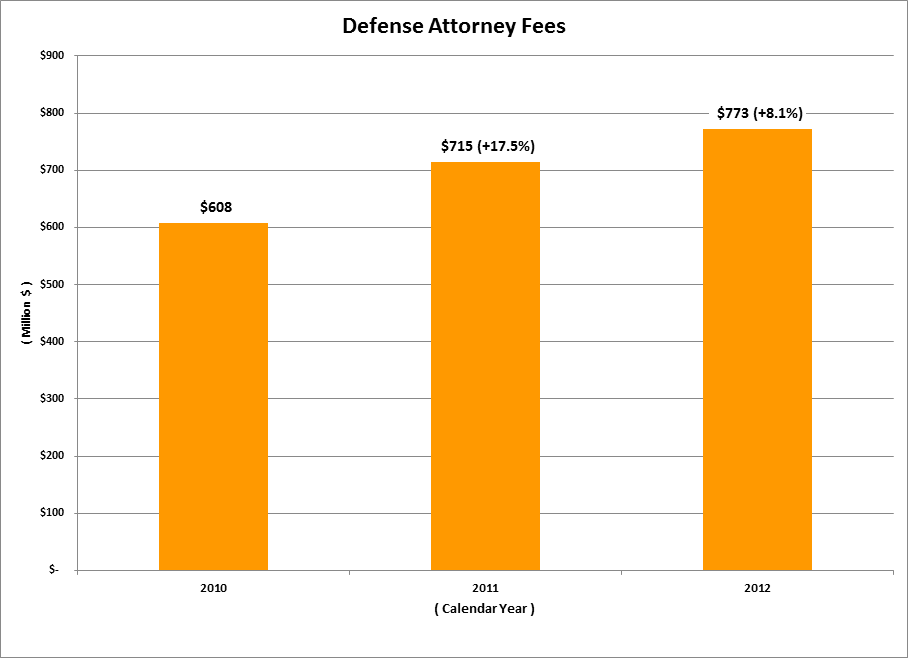
In contrast, the California Workers' Compensation Insurance Rating Bureau last reported gross total attorney fees in California for 2012 was about $1.223 billion. Applicant attorneys got $450 million of that gross, and the defense was paid about $773 million.

Fees in California have been growing at about 8 % per year since just a couple years after Schwarzenegger's SB 899 sharply curtailed the benefits upon which most applicant attorney fees are based.
image002.png
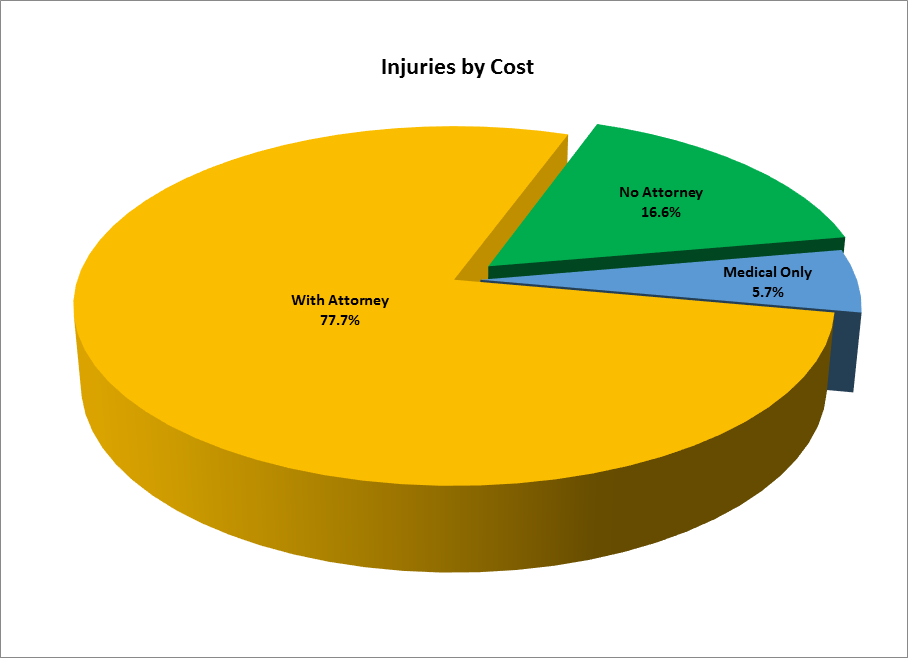
Indemnity claims in CA with an attorney are 78% of all claim costs. 

I was curious about how California stacked up against Florida - both states are known for being particularly litigious in workers' compensation.

A walk around the exhibit floor at the annual Workers' Compensation Institutes conference in August impresses one with all of the defense firm exhibits (and parties).

California lawyers on the other hand each have their own conferences, and even still defense firms will exhibit at some of the other employer or carrier based conferences in the state.
image003.png
In contrast to FL, CA defense fees have continued to grow.

So while this is not a scientific study, and in fact I'm not even comparing apples to apples because the dates of the data collection are different, and there are other serious issues with this analysis that any competent high school statistician could tear apart, it is interesting nevertheless in terms of seeing where a big part of the money goes.

One comparison is just how big of a market are we really talking about.

For instance, California's gross written premium for 2013 according to the WCIRB was about $14.8 billion; the national gross written premium according to the National Council on Compensation Insurance was about $41.9 billion (includes state funds and private carriers).

So California represents about 35% of the total gross written premium of the entire nation.

According to NCCI's last report Florida's total gross written premium for 2013 is $3.21 billion, or 7.7% of national gross.

If we compare attorney fees as reported above to gross written premium, then for every premium dollar collected in California, twelve cents went to attorneys.

In Florida that ratio is 8.4 cents; a difference of about 30%. In other words, if you're going to be a lawyer in workers' compensation, California is about thirty percent more lucrative than Florida.

If we compare how much goes to defense representation as opposed to injured worker representation, the ratio is very close.

In California the ratio is 1.72. In other words for every applicant attorney dollar the defense spent a dollar and seventy two cents.

In Florida the ratio is 1.69; a very similar ratio.

Defense attorneys will defend (pun intended) their fees because work comp is "long tail" so they are working on cases that may be years old, or that they need to deal with issues that claimants don't such as resolving unsettled medical expenses.

Whatever - the point is that there is a lot of work available for attorneys, particularly defense attorneys, in workers' compensation. Just look at WorkCompCentral's job ads!

Sometimes I wonder if I should have stayed the course and remained a defense attorney instead of founding WorkCompCentral.

Nah....

Wednesday, November 12, 2014

Just The Way It Is

Anyone that doubts that workers' compensation is a "political compromise that obfuscates medical science to achieve a financial outcome" simply needs to read this morning's WorkCompCentral story about Illinois governor-elect Bruce Rauner, and the anticipated strategy the Republican plans to use workers' compensation as a bargaining chip to achieve other promised campaign goals.

Democrats hold about 60% of the vote in the Illinois legislature so whatever Rauner comes up with, to be successful, will need Democratic support.

And while Rauner never clearly outlined exactly what kind of reforms he had in mind during his election campaign, Michael Lucci, director of jobs and growth at the Illinois Policy Institute, noted for WorkCompCentral that Rauner said he would raise the minimum wage in the context of reform for workers’ comp and other tort liabilities.

“You can see that he is sort of framing a compromise there,” Lucci said.

Illinois went through a big reform of its system in 2011, but the state has been criticized for lagging in its execution resulting in a number seven ranking of the most expensive work comp states according to the last Oregon biennial study, although Illinois was ranked fourth in the nation when the last study was published in 2012 indicating some progress in shrinking costs, primarily by reducing medical treatment payments.

The pro-business lobby in the state is crowing that it's next border state, Indiana, has one of the lowest rankings in the Oregon study.

This of course, in my opinion, is a red herring argument - any business that says that it is moving to another state only because of workers' compensation evidences to me a management that doesn't know how to control its other costs since work comp is really a very small part of a business' overall expense budget; there's a lot more problems under the hood than just work comp.

Here's the political challenges facing any more tinkering with the Illinois system at this stage:
Otto Von Bismarck

1) Republicans and pro-business leaders want to change the causation standard to make it more difficult for workers to make a claim for benefits. Labor opposes this idea, and says that more insurance industry regulation is needed.

2) Illinois has gone through major changes to its comp system 3 times in the last 10 years - Rauner faces legislative fatigue on the issue.

3) Rauner is tying a promised minimum wage increase to $10 an hour to workers' compensation and tort reform, attempting to forge a compromise between Labor and Business in a face off where both sides must essentially come to the bargaining table in order to make any changes - Lucci says the members of the Illinois Workers' Compensation Commission must all sign off on any changes that are made to the policy, making some reforms harder to push through than others.

What's interesting about the minimum wage issue is that on Election Day, 67% of voters supported an advisory initiative to raise the state’s minimum wage to $10 an hour, reflecting Illinois' strong Blue roots.

Regardless, workers' compensation has always been a political compromise clearly dating back to the very first iteration introduced by Otto Von Bismarck in his 1884 Workers' Accident Insurance system.

I've said before that workers' compensation works as it is designed, but not as it is intended. That is because it is, always has been, and always will be, a political tool tied to unrelated social objectives of elected officials (or perhaps more often the objectives of those financing those politicians).

And that's just the way it is.

Tuesday, November 11, 2014

Vultures At Both Ends

Yesterday I espoused about our industry penchant to make a very simple proposition much more complex and difficult than necessary. We introduce all sorts of officious intermeddlers into the system and, I believe, that when we really get down to it anything that wrong with workers' compensation is our own doing.

Even on this own blog you are likely to run into advertisements like this one:
Would you click this ad?

Clicking on this ad will take your browser to http://workers-compensation-law.us where you will find "Free Workers' Compensation Help - Get your FREE, no-obligation evaluation today and find out how much your claim is worth."

This is obviously an attorney referral service, and frankly is probably against state bar rules in many states - but how can that be regulated effectively over the Internet and across the nation?

The website says that when you submit your information you are going to be contacted, and not necessarily by an attorney, but probably by a slick telephone sales person that will prey upon your work injury weakness and ensure that you are directed to one of their referral clients:

"By submitting your request, you grant permission for up to two of our premier partners to contact you using the phone number or email address that you have provided so we may assist you with your request for a free case evaluation and potentially an offer of representation and services. You agree that the matched partner may use an automatic telephone dialing system even if the number you provided is a wireless phone number. You understand that consent to being contacted is not a condition of purchase or acceptance of services of any kind."

Click around and you are taught that it's probably a good thing to get an attorney through this referral system:

"By law, you have the right to represent your own interests when filing a workers' compensation claim. You are not required to hire an attorney. However, because the process of filing a workers' compensation claim can be complex, many injured workers hire a legal professional or an attorney to advocate on their behalf. This is to ensure that they receive the maximum amount of compensation for which they are eligible."

The advertisement play hard on the adversarial nature of employer versus employee, I'm sure hooking every injured worker out for revenge:

"If you are an injured worker that has always worked hard for his or her employer, it may be difficult to accept that you can no longer work in the same capacity as you once did. Moreover, you may also have personal issues with receiving the assistance you need to sustain yourself. An attorney or legal professional can help to ease the burden and stress of dealing with the complex and bureaucratic process of receiving compensation. Furthermore, dealing with the complexities of the workers' compensation process as well as the emotional and physical strain of a debilitating injury is overwhelming for most people. An attorney advocates for you and eases many of the legal and emotional hassles so you can focus on recovery or rehabilitation.

"Insurance companies and state agencies are focused on giving you the smallest amount possible for your injury. They are professionals and deal with this system on a daily basis. Their experience and knowledge of the system is a tremendous asset in contested or difficult claims.

"If you are injured you deserve the maximum amount allowable in order to take care of yourself and your loved ones. A competent experienced attorney or legal professional will ensure that your claim receives the benefits you deserve."

The salacious solicitation goes on and on with predatory appeal to emotions surrounding entitlement mentality, insecurity, retribution and vengeance, and of course just plain greed.

BUT IS THAT ANY WORSE THAN THIS?

From a recent post on the WCC forums:

"I have found at least one major CA UR company is limiting 50 pages of medical documents allowed when appealing a UR denial. If more than 50 pages are sent, they call the claims adjuster and ask for approval to review more records. If the claims adjuster says no, then they stop reviewing records at page 50. There is nothing in the states rules and regulations that state such a limit. I did ask if they notify the person who sent the records, either the doctor, attorney or injured worker when they do not review all of the records. The answer I got from a UR supervisor was "no, the claims adjuster is our customer and we have to do what he says, if he does not want us to review more records or does not want us to review certain records we do not". I was advised to ask the claims adjuster about this as they only do what he states they can do."

ARE YOU KIDDING ME?

So let's drive the claimants to attorneys with nonsense like this. Limiting the quantity of records that are sent to utilization review is, in my mind, not only against the Labor Code and regulations concerning UR, but is both a sanctionable event via hearing before the Workers' Compensation Board (I know, claims LAUGH at penalty attempts now a days since they were essentially eviscerated by SB 899) and California Audit Unit (which as we have seen in prior posts is laughably meek as well).

It seems to me that this claims directive of randomly limiting the number of pages of records to 50 in order to save a couple scheckles is practicing medicine without a license. It's also behavior that intentionally deprives an injured worker of a fair review even if the UR company isn't also owned by the claims house or getting kickbacks, or some other nefarious financial interrelationship that is of questionable ethics.

“Analytics can give you a sense of which types of claims result in litigation, how much it can cost and can perhaps tell you how to alter the claim management so, again, there is less likelihood of it resulting in litigation,” Robert Hartwig of the Insurance Information Institute said in a story this morning in WorkCompCentral News.

Guess what folks, you don't need analytics. You just have to look at examples like the one above to understand what needs "alteration."

I've said it before and I'll say it again, and again, and again ...

THERE'S NOTHING BROKEN ABOUT WORKERS' COMPENSATION!!!

The only problem the system has is YOU.

Feed the system crap and you get crap.

Monday, November 10, 2014

Capitalists, Labor and Work Comp

An interesting realization came to me lecturing at the American Academy of Orthopedic Surgeons Workers' Compensation Course this past weekend - debating how to get the patient better, to return to work, to obtain the best outcomes medically, and all of the rest of the banter has nothing to do with making workers' compensation actually perform the way it was designed. These are doctors that really care about what they do in work comp and they get frustrated because they are scientists and linear thinkers, and they have a difficult time accepting areas of gray (e.g. "lighting up" a pre-existing condition).

I talk with a lot of them and, like many in the industry, they believe that workers' compensation is a broken system rife with fraud, dereliction and dysfunction.

The truth of the matter is that, while workers' compensation isn't the most efficient and functional system in the world, it has the ability to perform just fine if we allow it to. But it seems to me that in our quest to do the best job that each of us has been assigned, we forget the how and why of work comp.

It all comes down to understanding capitalism and its relationship to labor.

Capitalism is the act of gathering up money, investing money into a business idea and then hopefully getting a return on that money.

Labor provides the means by which capitalists are able to obtain a return on investment. Without labor, machines don't run, design doesn't occur, trenches don't get dug, trucks aren't driven. I use labor in the broad sense - each person that works provides a service, labor, that allows things to get produced and services to be provided.

And just as labor provides the means for capitalists to get a return on investment, capital provides a means by which labor is able to eek out a living - usually.

Don't confuse the capitalist with the employer - they are two different things. The employer is the mode by which deployment of capital occurs; the conduit by which money is managed through labor (and "hard" assets) to build the widget or provide the service.

While the economics of work comp are a bit more complex than this simplistic view, as long as the roles are understood it really is pretty simple.

First - employers do not pay work comp premiums. Employers collect work comp premiums from consumers of the services or products that are the product of capital and labor by adding the cost into the price of their product or service.

For the average employer, it is a zero sum game. For the employers that are really bad at managing their work environment it is a good deal more punitive. They may argue that work comp premiums drove them out of business but I'd guess they were really poor businessmen and there were a dozen other things that contributed to their demise.

I don't buy that workers' compensation in any state has ever driven business out of a state to another in and of itself. For the vast majority of businesses workers' compensation is tenths of a penny on the overall dollar. Workers' compensation may be a contributing factor, but it is not a reason in and of itself.

And I don't buy that workers' compensation drives business under ground. Contractors for instance have a whole host of employment related issues that influence under the table compensation to the workers, not the least of which is culture, which is tied to greed, which is the product of ... 

And I'm not going to discuss that work comp is a government mandated social contract here. We've covered that topic many times before. Suffice it to say, 'It exists - it is the Law' - just like traffic laws, tax laws, and environmental laws. I don't hold much hope that the legislators will figure out how to craft more laws to have an effective and fair system. They have been at it for 100 years and one could argue it's worse now than when it started.

Karl Marx' "Das Kapital" should be required reading for every economist, legislator, and business owner. His text clearly defines capital and labor in great detail. He states that without Labor, Capital is dead. Without Capital, Labor cannot subsist (at least not since the Hunter-Gathers 300,000 years ago).

The combination of Labor and Capital is designed to produce a Surplus (after the return of Capital and paying for the subsistence of Labor). Where we in America take issue with Marx' work is that he believed Surplus should be distributed to Labor. Obviously I, and most Americans, disagree.

A friend of mine did a study of the Fortune 500 - arguably the largest concentration of employers - a while ago to figure out this relationship between Capital, Labor and Surplus. Here's how the numbers break down: Before one employee can come to work (and run that drill press or whatever) some Capitalist has to put up $127,000 in capital. Of that amount, 57% is equity and the other 43% is borrowed.

At the end of the year, the employee has had guaranteed wages and (hopefully) some benefits. The Capitalist has, on average, earned around $2,400 per employee for his efforts. This compares to the average wage of $50,000 plus for the worker. Of course those numbers are generalizations and are a blend of some making much more and some losing a lot more.

Don't get me started on Management compensation. A) They are not the Capitalist, and; B) Their conduct and compensation has the implicit approval of those who are the Capitalist - not to mention the legal mandate to maximize the profits of the shareholders provided it is within the Law.

All these arguments about how the work comp system is broken and it is Corporate America's fault are nothing more than Red Herrings. The simple fact of the matter is that the behavior of people, and remember corporations are people (the United States Supreme Court told us so!) is what we have a problem with.

Whether that behavior is reasonable or not is balanced by what the Law says is reasonable, and when the Law doesn't tell us what is reasonable then we are left to our own ethics and morals.

Sometimes, as we all know, ethics and morals don't necessarily align; some folks have looser standards than others, some have tighter standards, and these are all tempered by what is demanded of each of us within all of our respective jobs.

It's time for us all to "Man Up" and take responsibility. The system isn't broken and it doesn't need to be fixed (God save us from another round of legislation designed to fix the system). Work comp is an Administrative system and it has rules and regulations. For the most part, those rules and regulations are designed to protect both the injured worker and the employer equally.

Is the clerk at Walmart slow and incompetent? Perhaps! But, that's where you go to buy things and despite the inconvenience or frustration you buck up and deal with it (at least my wife does - I get too frustrated to shop at Walmart...).

Is the clerk at the DMV slow and incompetent? Once again, perhaps! But, that's where you go to get your license and registration so you get in line, put up with the malarky, and get on with it!

I have never been able to make anything come about because I whined about it - in public or in private; vocally or in writing. The ONLY time I've ever been able to effectuate change is to just do it. We can all talk. We can all write. We can all do all sorts of things that don't accomplish anything.

Collectively, we can "Make Work Comp Work." Collect the premium or reserves. Pay the bills, and provide the treatment.

And we can do this without all of the phony baloney intermediaries that provide zero value to the basic equation of work comp: which is spreading the risk of financial ruin due to an occupational injury, be it employer or employee.

If you don't like the way the law works, if you don't like having to pay for an exacerbation of a pre-existing ailment, if you don't like restrictive medical treatment, if you don't like the increase in premium, there's a simple solution - immigrate to a nation where there are no such protections!

There's a reason why third world countries are, and remain, Third World - because Capital, Labor and the relationship between them are distorted.

As I tell the physicians that attend the AAOS course work time and time again, "workers' compensation is a political construct that obfuscates medical science to achieve a financial outcome."

Start telling that to anyone that will listen.

Friday, November 7, 2014

Have A Kick Ass Day

Dwight Johnson lost both legs in separate industrial accidents.

But when he was really down he thought of his seven children, his wife, and the rest of his life.

“I was laying in the hospital bed and I asked the nurse, I said ‘Give me the red button and leave it on; I’m done’,” Johnson told CBS News in an interview.

Johnson's job was inspecting skyscrapers. The first occupational injury was incurred on a trip to Hong Kong for work, when he developed a staph infection. Three days later, his foot was dead, and his only option was amputation.

After that first ordeal Johnson returned to work on high-rises with the use of a prosthetic leg.

“I basically had to learn how to walk all over again, like a child,” Johnson said. “All your balance, you learn your core, and where your balance is, and then you go from there.”

Round two occurred a year and a half ago when he was was struck by a transit bus while crossing the street in New York City, again on the job.

This put Johnson in a deep hole, and he initially refused to see a doctor because he knew amputation was imminent.

“We went through a couple nights where he wasn’t going to go, and I kind of had to give him an ultimatum that he had to go,” his wife Debbie says on the news report. “Otherwise, he would have died on me right in the house.”

“Something just told me I could do it,” Johnson said. “With the seven kids and my wife, I wasn’t ready.”
Dwight Johnson with his best "kick-ass" scowl!

Tom Nomura is Clinic Manager at Hanger, the Newport Beach company that created Dwight’s new legs and providing rehabilitation.

“He had to go through rehab each one of those times,” Nomura explained. “So it was his perseverance and his determination that really made it work for him.”

Johnson says he's in pain every day, takes medication all day long, but still says, "I'm not ready to sit in a chair."

Besides returning to the work force, Dwight and Debbie also began work with Amputee Empowerment Partners, to assist other amputees in their own transition into new routines.

Dwight's goal is to inspire amputees who remain in their chairs to work with their prosthetics.

“I meet a lot of people that are still sitting in their chairs, and they have prosthetics and they won’t put them on," he says. "So, I’m hoping this will entice somebody to get up off their rear and get up and go.”

Dwight's favorite sign off phrase is, "have a kick-ass day."

Dwight will be the motivational speaker at the 3rd Annual WorkCompCentral Awards and Gala on December 6.

Get your tickets now, they're going fast, and you will have a "kick-ass day."