Tuesday, December 9, 2014

Frequency and Posting

A funny thing happened in my travels yesterday.

It was reported that California claim frequency in the last measurement largely ameliorated and started reversing trend, albeit still growing compared to the rest of the nation.

The Workers' Compensation Insurance Rating Bureau's Actuarial Committee, the folks that crunch carrier supplied data to figure out things like recommended rates and for prognostications, said that claim frequency in the first nine months of 2014 grew at an annual rate of 0.9%, compared with an increase of 3.9% last year.

The greater Los Angeles area continues to fuel frequency, which is insurance geek terminology for the amount of claims.

“If you (take Los Angeles) out of the picture, California actually looks pretty close to the national numbers,” WCIRB Actuary and Vice President Tony Milano said in a presentation last Wednesday.

Milano said the committee didn’t identify any one industrial sector in the Los Angeles area pushing claim frequency, but that the trend appears to be coming from all sides.


The WCIRB said part of the increase is the recovery of the construction industry - a high hazard occupational group - as house building and the economy improved.

Also going up are the agriculture, mining, entertainment, hospitality and manufacturing sectors.

No other state has such a diverse economy and accounts for as many risks.

That entertainment and hospitality claims are increasing may be a signal, again, of a positive economy, though of course this doesn't exactly explain why the Los Angeles area bucks national trends.

According to reports, there is a corresponding increase in cumulative trauma injury claims, and carriers are denying those more aggressively.

Which also might explain the increase in attorney involvement in California claims - as I wrote yesterday, the usual reason a claimant seeks legal help is because someone on the other end of the claim said, "no."

The WCIRB reported that employers and insurers denied the compensability of injuries to all claimed body parts in 66% of cumulative cases last year, compared with 57% in 2012, 41% of which were from terminated workers, compared with 38% in 2012.

In fact, the Workers Compensation Research Institute found in 2012 that about a third of all California applicants hire legal representation.

The WCIRB Actuarial Committee showed that 81% of cumulative injury applicants used lawyers in their cases.

And the how and when data is gathered, crunched and then reported as statistics distorts the picture a little bit. As Dave Bellusci, Chief Actuarial for the WCIRB, said, "These are often added late, they’re typically litigated, they’re just a different animal and they’re a big issue in California."

The pessimist will note that claims frequency still grew while the rest of the nation continued trending downward. The optimist will note that while there was frequency growth, it was very small compared to the past couple of years (see chart).

In the final analysis, though, my travels (see beginning) had nothing to do with the WCIRB report or my consumption of the news. It was just an easy way to open this post.

Which is another way to say that the news isn't terribly disconcerting because, other than the Los Angeles area, California trends just like the rest of the nation.

Why Los Angeles is so special is likely fodder for another study, another report and another post.

Monday, December 8, 2014

The Word: Uncertainty

Uncertainty.

That was the "Word on the Industry" that WorkCompCentral editors decided what best describes California workers' compensation at present.

It was the theme of my opening presentation at the WorkCompCentral Comp Laude Awards and Gala Saturday at the Sheraton LAX Gateway hotel where I summarized this comprehensive "story behind the story."

About 350 people from the industry, or affected by the industry, attended to hear not only the Word, but to hear panelists Christine Baker, Mitch Seaman, Sean McNally, Robert Rassp, and Bill Zachry discuss and debate SB 863, its status and whether it was meeting expectations (James Butler unfortunately was unable to participate because of an untimely injury).

A 2012 Workers’ Compensation Research Institute study found that nearly 30% of injured workers in California hired an attorney. That's more than any other state except for Tennessee and Maryland, and those systems aren't even close in size or expense.

The California Workers' Compensation Institute found that permanent disability claims filed between 2005 and 2010 were more than twice as expensive when lawyers were involved. Average cash and medical payments for permanent disability claims increased to $61,092 with an attorney involved, compared to $24,874 without a lawyer.

Attorney participation in claims has been growing.

In 2003 the CWCI found that attorneys were involved in 76.2% of all permanent disability and 29.9% of all indemnity cases. In 2014 CWCI found attorneys were involved in 80.4% of PD cases and 38.3% of indemnity claims.
image002.png
Attorney involvement greatly increases costs.
And it's not just about attorneys - when cases involve attorneys medical bills inflate, as does duration of disability thus inflating temporary disability indemnity numbers and time off work costs.

Though it's easy to blame attorneys for all that ills California's system (where gross fees for counsel on both sides of the fence totaled nearly $1.2 billion in 2013) this fact is simply a symptom and not a cause.

Most of the panel members defended SB 863, saying it needs time to work out, and that it was designed to remove uncertainty.

But Rassp said that SB 863's complexity is frustrating and confusing to injured workers, and drives them straight to attorneys.

With this latest reform effort, Rassp said, "what we're seeing is a sea-change in our law practices," and a lot of workers walking into our offices, "frustrated as hell."

He opined that workers hire an attorney for the simple reason that "someone said no."

Motivational speaker at the Gala, Dwight Johnson, after everyone wiped the tears from their eyes hearing his strong story about two separate industrial accidents end in two separate amputations of both legs, summarized it best in first person experience: the whirlwind of laws, regulations, people, and decisions on top of the fear of an insecure, precarious future, drives the California injured worker to seek counsel.

And it was a "no" that drove Johnson to an attorney - utilization review denied Johnson's request to outfit his bathroom with disability hardware so he could take a shower forcing him to travel to a community pool to utilize facilities there just to clean up every day.

"To be as diplomatic about it as I can," Rassp said, "the more laws and regulations that exist on a given subject, the less common sense applies."

Uncertainty - the law is unsettled, people don't know where to turn, nonsensical decisions are made, inappropriate communications occur...

Maybe 863 needs time. Maybe folks need to step back a bit and understand what it is they're being asked to do. Maybe people need to pay attention to what is actually happening.

In the end though, as Johnson concluded, "be gentle, be kind."

That mindset could go a long way towards softening uncertainty.

Friday, December 5, 2014

They Didn't Riot

With all of the racial tension in this country tied to police activity and grand juries waiving indictment of officers blamed for excessive force against blacks, the Commonwealth Court of Pennsylvania overturned a Workers' Compensation Judge's finding of mental injury from a combination of racial and sexist harassment.

In Frog, Switch & Manufacturing Co. v. WCAB (Johnson), No. 149 C.D. 2014, Lindora Johnson was one of only two women and the only African-American female in a workforce of approximately 200 employees at the Frog Switch manganese steel castings manufacturing plant in Carlisle, Pennsylvania.

She claimed that she suffered repeated incidents of harassment at work during a five-month period in 2009, where her male colleagues made disparaging remarks about her gender, used a racial epithet in front of her and hung a noose inside an office where it was visible from the women’s locker room.

Johnson stopped going to work in September 2009 after she burst out crying in a meeting with management and a coworker who had complained she didn't operate her overhead crane safely.

A workers' compensation judge found Johnson had developed atypical depression as a result of her exposure to abnormal working conditions at her job. The judge awarded her TTD from Sept. 30, 2009, until April 19, 2010, when Johnson returned to work.

The WCJ's award was based on three separate medical evaluations who found that Johnson had, "job-related stress," that was suffering an emotional stress reaction, and that she had depression based on “her stressful and overwhelming work conditions.”

The WCJ did not find credible Johnson's coworkers testimony that the noose was a joke directed at a coworker who had said he was "going to hang himself" because of things that kept going wrong. The judge also gave weight to Johnson's testimony that her colleagues had used "the N-word" in her presence, had said females shouldn't be working at the foundry and warned each other not to work below her crane.

"It should be abundantly clear that any reasonable person, let alone a reasonable African-American female in an all-male and virtually all-white environment, would perceive references to the ‘(N-word),’ a noose, and comments about refusal to work under her crane, or that women don’t belong, as degrading and hostile," the judge opined.

A split Commonwealth Court found Johnson's medical evidence didn't establish an industrial cause for her distress.

The the record must contain unequivocal medical testimony to establish the causal connection between a psyche injury and employment for the injury to be compensable, the majority, in an opinion by Judge Anne Covey, said.

"Due to the highly subjective nature of mental injuries," she said, "an injury’s occurrence and cause must be specifically delineated" by the medical experts.
From http://www.blackactivistzine.org/

A claimant further bears the burden of proving that the psyche injury was "more than a subjective reaction to normal working conditions," Covey added. However, she said there was no reason to decide whether Johnson's injury was the result of an abnormal working condition since Johnson couldn't even prove her condition was work-related.

Two justices dissented, stating that the record was "replete with testimony from both sides that these reprehensible incidents did occur and that claimant became upset to the point where she lost control at work and left to see a doctor."

From the time Johnson first sought medical treatment for stress, she indicated that it was due to continual harassment at work based on her gender and race, Justice Bernard McGinley noted. Even though Johnson's care providers didn't specifically mention the "noose incident" and "the N-word" in their reports, McGinley argued that "the only reasonable inference to draw" was that these events were what the doctors were talking about.

The argument among experts interviewed for the WorkCompCentral story on the case opine that either the Commonwealth Court was engaging in inappropriate fact finding, or conversely, that they correctly noted there was no nexus linking the work incidents and Johnson's doctors conclusions in the various reports.

Maybe they're both right. Fact finding, which is the sole province of the trial judge, includes making ultimate findings of fact; i.e. factual conclusions. In this case, that there was a connection between work place harassment and the claimant's mental injury.

Likewise, though, there must be substantial evidence to support an award, and part of that is an expert's opinion on causation; while a physician may conclude that there was a mental injury related to the occupation the doctor should be connecting the dots with specific factual references in the report.

Unfortunately we don't know what happened after Johnson returned to work.

And so far there are no reports of rioting in Pennsylvania.

Thursday, December 4, 2014

The Long Tail

It's been nearly 22 years since "open rating" was brought to California, supplanting Department of Insurance mandated minimum rates.

SB 30 dramatically changed the landscape in California. Oodles of small, specialty carriers writing very niche industries disappeared almost overnight.

Bigger carriers with national footprints used their financial clout to compete on price, creating a relatively short term boon for employers as premiums plummeted.

Underlying a big part of this pricing bonanza for employers was the reinsurance scheme brokered by Unicover Partners, which I and the national business press have written extensively about.

While employers enjoyed unprecedented savings, the trouble brewing within the carrier markets was starting to cause indigestion. Ultimately, around 1997 or so, the carriers that relied on the Unicover brokered reinsurance started coming up short on cash because the reinsurance companies weren't paying claims.

It seems that as these reinsurance treaties were sold up the chain until ultimately someone figured out what the liability was going to be. Those companies returned premium and denied the risk.

One of the biggest primary carrier participants in the scandal was work comp stalwart, Reliance Insurance Company, which had been in business for a 184 years. Unicover ultimately took down that great company.

It's said that workers' compensation is a long tail beast, but this is generally in reference to claims.

But the aftermath of Unicover on the industry shows that the long tail follows the business side of comp too.

Reliance didn't just write workers' compensation insurance, so its demise meant the disintegration and restructuring of several lines of insurance.

To say that work comp disrupted an entire property & casualty business is an understatement - in the case of Reliance, it was devastating.

The Pennsylvania Insurance Commissioner, tasked with the liquidation of Reliance (since Reliance was domiciled in that state) is still working towards settling the estate.

Reliance owed $10 billion in claims and was insolvent by $1.1 billion when it went under.

At the time there were about 144,000 claims pending with various reinsurers, most of which undertook those obligations under the Unicover treaties.

Part of the effort the commissioner's office has undertaken is to get settlement agreements with the reinsurers involving commutation of future claims to liquidate those debts and finalize the estate of Reliance, and to bring in cash needed for administrative expenses as the firm is wound down.

Last month, Insurance Commissioner Michael F. Consedine reached two settlements with Swiss Re, which had provided reinsurance for several Reliance coverage obligations, to commute its reinsurance obligations.

The first settlement covers a group of workers' compensation policies that Reliance had issued between 1996 and 2000 for a payment of $6,590,080. The second settlement commutes Swiss Re's reinsurance obligations for a group of Reliance workers' compensation, general liability and auto policies issued between 1988 through 2000 in exchange for payment of $7 million.

These deals are pending court approval.

The court overseeing the Reliance liquidation has approved multiple commutation agreements submitted by Consedine and his predecessors over the years. It has been taking the court an average of about 30 days to rule on each application for approval.

Two years ago, Swiss Re agreed to settle its reinsurance obligations for policies Reliance had issued to Administaff, Catholic Health East, Labor Ready, Lowe's, the May Department Store and Waste Management for $23 million.

It paid another $19.858 million in January 2012 as a commutation of its obligations for a group of Reliance health care liability policies, and last year, it shelled out $7.750 million to free itself from future obligation for 98 reinsurance policies covering workers' compensation policies that Reliance wrote between 1993 and 2001.

The insurance commissioner has also reached commutation agreements with Munich Reinsurance America, the SCOR Reinsurance Co., Centre Reinsurance (U.S.) Limited,Hannover Rueckversicherung AG, the Connecticut General Life Insurance Co., the Phoenix Life Insurance Co., C.S.C. Assurance, Swiss Re Life & Health America, the Finial Reinsurance Co., and the General Security National Insurance Co., in the past three years.

In 2000, Forbes business writer Robert Lenzer wrote of Unicover as it unraveled, "The potential fallout is huge: the possible disintegration of Saul Steinberg’s Reliance Group, the potential bankruptcy of several California insurers, numerous credit downgrades and the likelihood of big charges to earnings in several widely held insurance companies."

Lenzer was dead on. What he didn't count on, however, was just how long this mess was going to take to clean up.

14 years, and still counting.

Long tail indeed.

Wednesday, December 3, 2014

Eliminate Relevancy

The claims paying community is having consternation about the California Division of Workers' Compensation's recent announcement that it is going to start fining them $500 per day, capped at $5,000, for each day that relevant medical records don't timely make it to the Independent Medical Reviewer.

The reason for the heartburn, they say, is that judges will once again end up deciding medical treatment rather than doctors - going against the intent of SB 863.

The DWC said that as of Monday it will commence the penalty procedure if IMR contractor, Maximus, has not received relevant medical records by Dec. 15.

The issue seems to be: what is "relevant?"

Under the provisions of SB 863, after Maximus accepts an injured worker's application for IMR, it sends a notice to the claims administrator that the case was accepted. At that point, the claims administrator has 10 days to send a copy of all the worker's medical records in its possession that are "relevant" to:
  • The worker's current medical condition.
  • The medical treatment provided by the employer.
  • The disputed medical treatment requested by the worker.
The claims handler must also send a copy of all information sent to the worker explaining the decision regarding the disputed treatment, all materials the injured worker submitted in support of the request for authorization and any newly discovered "relevant" medical records. Finally, the claims administrator must send a copy of "any other relevant documents or information used by the employer or its utilization review organization in determining whether the disputed treatment should have been provided."

According to Maximus, about 19,000 of the 42,000 cases that were pending as of Oct. 22 were missing medical records after the deadline for submission.

This is again an example of the system working as it was designed, not as intended.

The design is flawed because the word "relevant" requires decision making, which is a gray area.

The simple solution is to require ALL medical records be sent along with the treatment dispute, regardless of relevancy.
Just send ALL the records...

Otherwise, if it's not a judge making a medical decision (determining what records are "relevant") then it's the claims adjuster - regardless, it's not a doctor making the decision.

Claims folks are going to cite the cost and expense of doing so, particularly in large files. It comes down to the numbers and I get that.

So, here's a simple way to avoid claims adjusters or judges from making medical decisions: determine the cost of the treatment appeal (UR or IMR) versus the cost of just approving the treatment. If the cost of appeal is more, then just approve the treatment.

Easy!

I know, there are complications like duration of temporary disability, probability of a good outcome, etc. etc. Those can all be factored in to the decision point.

Here's a proposed formula:

Cost of treatment + anticipated TD + anticipated PD = $X

vs.

Cost of all records + TD pending appeal (say 30 days, but given usual delays 60 may be better) + anticipated PD without treatment + anticipated TD post denial of treatment (if any) + TD (again if any) pending judicial review (90 days if expedited) + TD (you know the caveat) pending WCAB review X percent of probability that judicial review will determine the UR/IMR timeline wasn't followed = $X

Build your own model ...

I know there isn't empirical evidence that claims folks are either intentionally omitting records, or filtering to achieve a desired UR/IMR result, but the fact is that 45% of all IMR requests don't include records Maximus reviewers have determined are necessary for a review decision.

That's a problem.

Not only are injured workers being denied and/or delayed on their treatment requests, but it completely undermines the credibility of the system and of the operational objectives of SB 863: provide more benefits to injured workers while saving employers money.

******************

Shameless Plug

Saturday at the LAX Sheraton Gateway Hotel WorkCompCentral hosts its 3rd Annual Comp Laude Gala and Awards. This is going to be Huge!

We start off at 1 p.m. and I will present WorkCompCentral's Word on the Industry - a review of the past year (and other significant events) concluding with a single word that WorkCompCentral editors have decided best defines the system.

Following Word on the Industry motivational speaker and injured worker, Dwight Johnson, a double amputee as the consequence of two separate industrial accidents, will tell us his story about injury, recovery, injury, recovery - and keeping life in focus through it all.

Then I will moderate a panel consisting of: Christine Baker, Director, Department of Industrial Relations; James Butler, Founding Partner at Butler Viadro and President of CAAA; William "Bill" Zachry, Vice President, Risk Management at Safeway, Inc.; Robert Rassp, Applicant Attorney, Legal Specialist and Author; Mitch Seaman, Member of the Governing Committee of the WCIRB (Worker's Compensation Insurance Rating Bureau); and Sean McNally, Member of Commission on Health and Safety and Workers' Compensation. We're going to debate SB 863: what's good, what's bad, and what are we going to do with it.

That's 3.5 hours of continuing education for professionals: attorneys, claims adjusters, QMEs, and others.

Drinks, food, socializing and networking follow and then the awards for the best in our industry.

We'll continue partying until 9 p.m. when the hotel kicks us out of the room...

There's special pricing if you bring a Toy for Tot or are a claims adjuster.

Go to https://ww3.workcompcentral.com/education/course/course_pk/830 for more information or just call 805-484-0333.

Tuesday, December 2, 2014

Texas and Comp or Not

Texas is the only state in the nation where workers' compensation has to compete with alternative risk management techniques for work-place injuries, or none at all. This gives us some interesting insight into the risk tolerance of employers, and what they're willing to pay for (or not).

And the latest biennial report by the Texas Division of Workers’ Compensation to the state Legislature about the state of occupational injury protection tells me that even with some of the most favorable rates in the country, employers still have plenty of issues with work comp.

About two-thirds of Texas employers carry coverage, meaning an estimated 80% of the state’s workers are under the work comp umbrella.

About 75% of the employers who don't subscribe have some alternative plan in place.

That doesn't necessarily mean that these plans are for the protection of workers either - could be that these are geared more towards risk management or mitigation strategy.

But regardless of the reason, 95% of private-sector employees in Texas have some form of work injury protection coverage.

The flip side is that the remaining 5% of private-sector employees who aren’t covered with any work injury protection total about 470,000 workers, 30,000 fewer than in the last report in 2012; but the percentage, 5%, is the same in both reports.

“Approximately 75% of the non-subscriber employee population is covered by some form of an alternative occupational benefit plan,” the report said. “As a result, an estimated 95% in the case of a work-related injury in Texas,” meaning either workers’ compensation coverage or coverage from a non-subscriber plan.
Texas Tribune graphic illustrates the numbers from the 2012 TDI report.

I'm not sure why the total population figure is different; perhaps there are fewer people employed currently in the state than there was in 2012.

Texas is a profitable state for the workers' compensation line with combined ratios in the past few years nearly always under 100. For carriers to make an underwriting profit on work comp is nearly unheard of. To do it consistently several years in a row is nearly impossible.

And this is with rates that are very reasonable compared to the rest of the nation, having dropped nearly 50% since 2003.

Still, the number of nonsubscribing employers grows - either employers feel they can get the same level of protection for themselves and their employees via alternative risk management systems, or they want more direct control over these systems, or they prefer to play the odds and just don't care.

“Despite lower workers’ compensation insurance rates in recent years, it appears that an increasing number of the largest employers in Texas have begun to opt out of the workers’ compensation system since 2010, while an increasing number of small and mid-sized employers have increased their workers’ compensation coverage rates,” the report said.

The percentage of nonsubscribing employers who have between 100 and 499 employees increased to 14% in 2014 from 12% in 2012. Nonsubscription also increased among Texas employers with 500 or more workers; 19% of such employers are now opting out, compared to 17% in 2012.

The nonsubscription rate among the largest employers had actually increased in 2012 as well, from 15% in 2010 to 17% in the last report.

The current 19% figure is still significantly lower than was reported in 2008, when 26% of employers with 500 or more workers were non-subscribers.

What's odd is that the report found slight decreases in nonsubscription for employers with five to nine employees – from 29% in 2012 to 27% in 2014 – and for employers with 50 to 99 employees (19% in 2012, 18% in 2014).

“Our reaction is that this remains a significant threat to the overall workers’ comp system,” Richard Levy, general counsel for the Texas AFL-CIO, told WorkCompCentral Monday. “It’s unconscionable that hundreds and hundreds of thousands of workers go to work every day with no protection against workplace injury, and until that is remedied, I can’t say that we have a healthy system.”

But Steve Bent, executive director of the Texas Association of Responsible Nonsubscribers, told WorkCompCentral that the latest nonsubscription rates were indicative of a system that’s working.

“As an association of nonsubscribers, we’re certainly not disappointed that the numbers are not higher,” Bent said. “It’s great that the workers’ comp system is working, and that employers don’t feel a need to opt out. However, workers’ comp rates have been somewhat cyclical historically, and if rates were to go up again in the future, we would hope that the ability to provide benefits outside of workers’ comp exists as a check valve or as a pressure valve for higher workers’ comp rates.”

Texas is an interesting study in employer psychology, at least regarding workers' compensation. Most of us, I'm sure, can't think of being without some work injury protection system in place. But there obviously is a sizable population that doesn't see it that way.

We see reports nearly daily of employers that either skirt mandatory work comp all together, or do their best to minimize premiums by underreporting payroll or misclassifying occupations.

Can you imagine if all states did not mandate some form of work injury protection?

We all have issues with workers' compensation and system performance. Sure, there are problems and nearly everyone has a story about denial, expense, coverage, fraud, etc. etc. etc.

And while we may debate the relevancy of workers' compensation in the modern employment era, at least we have rules in place with the intent of mitigating risk for both employers and employees.

Work comp is not perfect. It never will be. The Texas report gives us a glimpse into why not - because there is a sizable population that prefer risk to themselves and their workers rather than the expense of risk mitigation.

The biennial report can be viewed here.

Monday, December 1, 2014

It's Not Debatable

This morning's WorkCompCentral story about the recent California Workers' Compensation Appeals Board's Significant Panel Decision in Bodam v. San Bernardino County, where the board reiterated that utilization review is invalid if it is made within the time frame allowed by the Rules of the Administrative Director but not timely communicated to the worker and treating doctor, raised this interesting observation:

"Attorneys on both sides of the bar are also voicing concerns that the procedure for making treatment decisions will now be the focus of the comp system instead of the actual provision of treatment."

And that seems to me to be an accurate analysis of the Board's recent activity - because the argument over whether a request was timely, and timely communicated, has nothing to do with actually providing treatment, and is a source of huge delay even if there is a request (and provision for) an expedited hearing and appeal.

In the meantime, the injured worker sits around, decompensating further, and the clock runs on temporary disability inflating indemnity costs.

Several commentators to the story essentially opined that a lot of litigation focus, which many said would increase in 2015 as a consequence, is going to be about who was served what, when and how.

Unfortunately that's as clear, and concise, an indictment of the work comp system in California as any, and in my mind demonstrates a long, historical trend of the system to recognize form over substance.

I was recently alerted to a post made some time ago on a forum hosted by my friend Bob Wilson's site, WorkersCompensation.com. The injured worker claims a very similar situation regarding UR that I had recently written about - inadequate supply, or failure to supply, necessary medical records (edited for clarity):
The 2015 Flowchart is even MORE about form...

"I know in my case through UR the UR reviewer is seeing cherry picked sections of my file. No AME reports are sent, because they specifically mention this. They don’t get the MRI’s, or the EMG tests that support approval because they mention it as part of the justification for the denial as 'no radiological evidence supporting need.' Well, if the carrier doesn’t send it of course there’s no evidence! My doc has sent it with his request for treatment and they STILL SAY THEY DON’T GET IT. I know for a fact they do because my doc is now copying me the entire set of docs he sends with each RFA. IC is pulling it and not sending it to the UR reviewer is all that I can conclude because I know it was sent!"  [Bold formatting original.]

I obviously don't know that in fact the file was "cherry picked." And I don't know for a fact that the statement "no radiological evidence supporting need" actually meant there were no radiological records, or conversely that the records that were reviewed did no support the treatment request.

But, the point is that the focus of the dispute gets steered away from what the treatment request is, to how that request was received and/or dealt with - i.e. form over substance.

And the conveyance and receipt of records is, essentially, a timeliness issue - if all of the records are not transmitted and/or received by either UR or IMR timely, if at all, then it is an issue for litigation before the WCAB. This would support the commentators to the story who said that 2015 will see an increase in litigation about who was served what, when and how in UR.

In 2013 defense attorney fees were over $850 million. Applicant attorney fees were about half that. I don't have the numbers for 2014 yet, but I suspect a continuation of the inflationary trend on fees (nearly 10% a year since 2011) which will put this year near a billion just for defense fees...

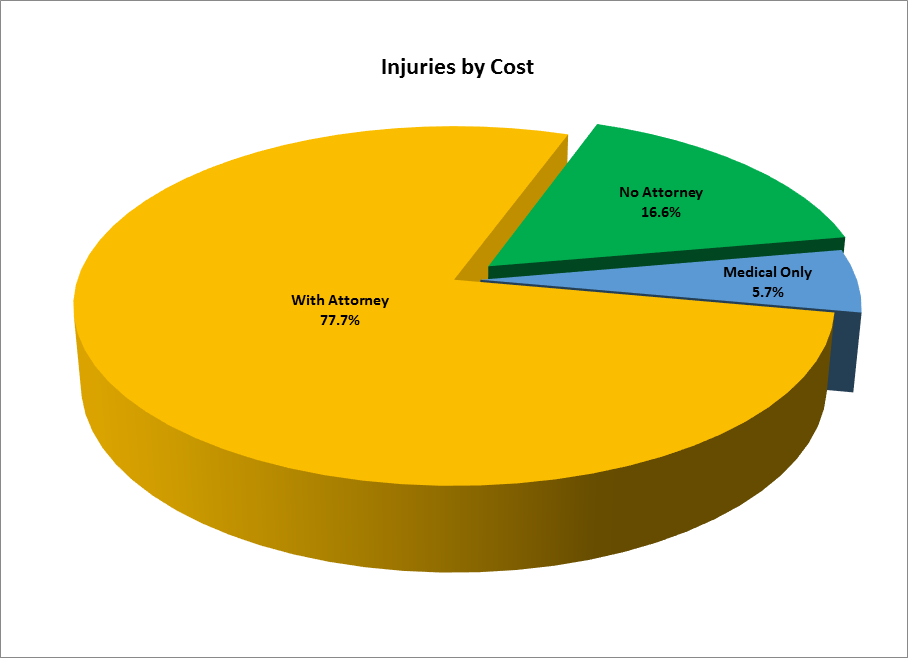
Litigated indemnity cases are disproportionately responsible for system expenses; about 11% of all work comp claims in California in 2013 comprised nearly 78% of all costs (2013 WCIRB data). Yet, the system drives litigation by creating disputes when there should be none.

There are only two main objectives in the delivery of workers' compensation benefits: provide medical treatment and indemnity.

That's it - very simple. Just two things need to be done: pay for the injured workers' medical care and give that worker some money to tie them over until they can take care of themselves once again.

The intent was, obviously, that physicians determine need for medical care and duration/intensity of disability. The logic is that physicians are experts - they have been schooled, trained and practiced medicine, so they know what they are talking about.

Workers' compensation was intended to be a self-executing administrative benefit delivery system. A dispute resolution process was integrated to provide a forum for the inevitable disagreements. That dispute resolution system was intended to expedite cases. That's why its administrative in its operation. It has very little to do with justice, or being fair, and very much to do with just making a decision, any decision, that moves the case towards some resolution.

But case decisions are increasingly about something other than the direct delivery of benefits. Dubon and Bodam are the most public evidence of this trend.

This coming Saturday a panel comprised of Department of Industrial Relations chief Christine Baker, SB 863 negotiators Mitch Seaman, Sean McNally, and Bill Zachry, and Norther California applicant attorney James Butler and Southern California applicant attorney Robert Rassp will take a look at SB 863 now 2 years into the law.

They will specifically be asked whether the law is accomplishing its goals (increase benefits to injured workers, save money for employers) and whether UR and IMR are actually working to direct appropriate medical care, or are just cost containment vehicles by which claims payers can deny benefits.

I expect the panel to engage in some contentious debate about these points. What I don't expect them to debate, because I don't think it's debatable, is the simple observation that the system does in fact work as designed: form over substance.

But the intent got lost in the design.