Showing posts with label florida. Show all posts

Thursday, June 16, 2016

Pulse

The mass shooting by Omar Marteen at the Orlando, FL nightclub Pulse shocked the nation, and has precipitated considerable debate about terror, guns, mental health, security, race and religion.

Increasingly reports are steering motive away from terrorism and more towards a hate crime, the product presumably of Marteen's internal conflict with his sexual identity.

The names of the 49 killed by Marteen have been published. Two were identified as employees of the club.

Kimberly Morris was a bouncer at Pulse nightclub. She was 37.

Deonka Deidra Drayton was a bartender at Pulse. She was 32.

We don't know yet who of the 53 wounded were employees of the club, if any.

Life takes a bad turn sometimes.

The mission of workers' compensation is to help when those bad turns happen at work.

I know the workers' compensation community, and in particular those in Florida, will provide to the victims and their families the best care and compassion they can.

Fulfilling our mission...

Friday, April 29, 2016

It's That Simple

Just yesterday I posted about Texas attorney fees and the debate in that state about adequacy.

And I previously I opined that 2016 was the year of Comp versus Constitution.

The Florida Supreme Court yesterday blended the two, finding that state's reformed attorney fee provisions, a product of changes made in 2003, to be unconstitutional under both the Florida state constitution and the US Constitution in the Castellano v. Next Door case.

In Castellano, the ultimate hourly fee attributable the work of Castellano's attorney amounted to $1.53 per hour because Florida Statutes Section 440.34 limits attorney’s fees to a sliding scale based on the amount of benefits obtained.

Even I made more than that as a law clerk in my first legal job during my second year of law school ($4.25 per hour...).

Strictly adhering to statutory law, Castellano had no ability to challenge the reasonableness of the $1.53 hourly rate, and both the judge of compensation claims and the 1st District Court of Appeals were precluded by Section 440.34 from assessing whether the fee award—calculated in strict compliance with the statutory fee schedule—was reasonable.

While the court acknowledged that the statutory fee schedule could, in some cases, result in a constitutionally adequate fee, it concluded that the irrebuttable statutory presumption of adequacy was unconstitutional because the fee cap applied to all injured workers regardless of circumstances, consequences or reasonableness: "the statute presumes that the ultimate fee will always be reasonable to compensate the attorney, without providing any mechanism for refutation."

EVERY injured worker is precluded from challenging the reasonableness of a fee is what irked the court.

The Castellano Supreme Court addressed only attorney fees, but dicta in the court's 55 page opinion suggests that, given the right set of facts, it would find other provisions unconstitutional (the court declined to entertain a facial challenge to the entirety of Chapter 440, revoking its grant of review and discharging its jurisdiction by way of a two-paragraph order in Stahl v. Hialeah Hospital yesterday as well).

"Yet, while the Legislature has continued to enunciate this purpose [expediency delivering benefits]," reads the opinion, "in reality, the workers’ compensation system has become increasingly complex to the detriment of the claimant, who depends on the assistance of a competent attorney to navigate the thicket. Indeed, as this Court long ago observed, allowing a claimant to 'engage competent legal assistance' actually 'discourages the carrier from unnecessarily resisting claims' and encourages attorneys to undertake representation in non-frivolous claims, 'realizing that a reasonable fee will be paid for [their] labor.'”

This theme is restated by the court several times in the opinion:

"The statute prevents every injured worker from challenging the reasonableness of the fee award in his or her individual case—an issue of serious constitutional concern given the critical importance, as a key feature of the workers’ compensation statutory scheme, of a reasonable attorney’s fee for the successful claimant."

And, "Stated another way, the statute establishes a conclusive irrebuttable presumption that the formula will produce an adequate fee in every case. This is clearly not true, and the inability of any injured worker to challenge the reasonableness of the fee award in his or her individual case is a facial constitutional due process issue."

Whenever someone has something that someone else wants, there's going to be disputes. Workers' compensation is no different.

The way we handle disputes in our civilization is through litigation. In workers' compensation, most of the time, it is an administrative court system. But there are still rules of procedure. And the substantive law isn't simple any longer either. Reading, interpreting and communicating a legal position takes particular skill - that's what lawyers are for.

When one is injured or ill the faculties for reading, interpreting and communicating, even if it is one's own fate, and even if one is a lawyer, are all compromised.

The payer side of the bargaining table knows this - defense attorney fees in key states have grown exponentially, particularly as compared to those representing injured workers.

I know, I know, I know - everyone hates lawyers.

Until one needs a lawyer.

The big concern from the Castellano opposition is that the ruling will cause insurance rates to increase significantly by encouraging legal participation. But there's a flaw to that logic.

Lawyers are only needed if there's a dispute.

So, either stop creating disputes or concede when a dispute arises.

Some will say it's not that simple.

Um, yes it is.

Thursday, April 21, 2016

Dismantling By Courts


ProPublica declared that corporate America was dismantling workers' compensation piece by piece, state by state.

But 2016 is going to be known as the year that state supreme courts are the ones dismantling workers' compensation piece by piece.

We have seen a very active Oklahoma Supreme Court declare various provisions of that state's 2013 reform law unconstitutional. California courts haven't gone in that direction, yet, though there are still various challenges to the 2012 reform law.

Florida courts have been asked to review various elements of its workers' compensation laws, and yesterday the First District Court of Appeals, in what I think was a surprising decision to many, said that the state's statutory limits on the payment of attorneys for injured workers was unconstitutional.

Florida Statutes Section 440.34 provides that a claimant attorney is entitled to a fee equal to 20% of the first $5,000 in benefits secured for a client, 15% of the next $5,000 secured and 10% of any amount secured in excess of $10,000.

The statute further provides that a judge of compensation claims cannot approve any other payment arrangement, and Section 440.105(3)(c) criminalizes an attorney's receipt of any payment that has not been approved by a JCC.

Many states have similar statutes or regulations limiting fees for attorneys representing injured workers in litigation. These rules not only assume that the only compensation schema applicable to this group of service providers is contingency based upon disability, they essentially perpetuate it thus perpetuating the disability of America.

I'm not sure that the 1st DCA is cognizant of this hypocrisy, but the justices at least acknowledge that an injured person's right to representation in a highly complex, life altering, legal system should not be castrated by a fee regulation that discourages any representation.

That's what occurred in Martha Miles vs. City of Edgewater Police Department, 1D15-0165, 4/20/2016.

Miles was a police officer for City of Edgewater. She alleged exposure from toxic chemicals used to make crystal methamphetamine on two occasions in 2011, and she claims these events aggravated her asthma to the point it became disabling.

She filed a comp claim, but after she voluntarily withdrew it, the city filed a motion to recover the $3,860.82 it said it had expended in preparation to defend itself.

Miles then went to her union for help. The Fraternal Order of Police Lodge 40 said it was willing to pay a law firm for Miles $1,500 for the first 10 hours of work, and Miles agreed to pay the firm $150 per hour thereafter.

But Judge Mark Massey found Sections 440.105(3)(c) and 440.34 prohibited the payment arrangement being proposed by the union and Miles.

Miles refiled her claim and wound up going to trial without an attorney, where she told the JCC that she hadn't been able to find anyone who "works for free." She failed to introduce any evidence to support her claim at the trial, so the JCC denied it.

Miles then hired attorneys Michael Winer and Geoff Bichler to appeal the judge's decision (though it is not clear how these attorneys got paid to make the appeal, but not the trial...). Their argument on appeal was that Sections 440.105(3)(c) and 440.34 violated Miles' free speech right guaranteed under the First Amendment to the U.S. Constitution.

The theory is that free speech is abrogated if an unskilled litigant cannot get adequate representation if no attorney would take the case because of inadequate pay; ergo an individual's right to contract freely (subject of course to legality) is compromised.

In addition the court noted that individuals can waive their constitutional rights, so they certainly should be able to waive a lower standard law, i.e. a fee constriction statute.

But by far the most interesting point made by the court was its overall criticism of legislative attempts to limit litigation: "[In] a free society which attempts to allow individuals the intellectual prerogative to personally weigh the benefits and risk of exercising their statutory right to obtain redress for their injury, we hold that the rational intent to minimize workplace litigation cannot ultimately trump the benefits the public obtains by allowing an injured worker, or one who personally thinks she is injured, to seek redress under law."

Perhaps the Miles case will go up to the Supreme Court, which would make it the fourth case pending before Florida's highest court on constitutional issues, perhaps not.

The wheels of justice, it is said, turn very slowly. While ProPublica observed that state work comp protections have been dismantled over the past decade, perhaps what we are now observing is that those very laws are now in the process of being dismantled by the courts.

Who said work comp wasn't fascinating?

Wednesday, October 14, 2015

Florida Takes the Lead

The Florida Supreme Court announced yesterday it has accepted jurisdiction in Stahl vs. Hialeah Hospital/Sedgwick.

"The Court accepts jurisdiction of this case as to the basis for jurisdiction under Art. V, § 3(b)(3), Florida Constitution (i.e., expressly declares valid a state statute)" says the Court's docket.

This is big.
FL Supreme Court


Florida's high court will be the first in the nation to weigh in on whether workers' compensation benefits have so eroded the Grand Bargain that it no longer meets state constitutional muster.

Daniel Stahl was injured while working for the Hialeah Hospital in 2003.

A doctor placed him at maximum medical improvement in October 2005 and assigned him a 7% impairment rating.

Stahl's case went before the 1st District Court of Appeals, which has original jurisdiction over all workers' compensation appeals, several times on various issues. His last appeal challenged the statutory imposition of a $10 copay on his doctor visits after he reached MMI as unconstitutional.

He also argued that the elimination of permanent partial disability benefits in 2003 makes the Florida Workers’ Compensation Law an inadequate exclusive replacement remedy for a tort action.

The 1st DCA said both the copay and elimination of PPD withstand rational basis review, in that the copay provision furthers the legitimate stated purpose of ensuring reasonable medical costs after the injured worker has reached a maximum state of medical improvement, and PPD benefits were supplanted by impairment income benefits.

Stahl says in his petition to the Supreme Court that the use of the "Rational Basis" test is improper since fundamental rights are impinged upon: due process of law, the inviolate right of trial by jury, the right of access to courts and the right to be rewarded for industry; arguing that the "Strict Scrutiny" test must be applied instead.

Covering the bases, Stahl says that even if the rational basis test was the correct standard, it was misapplied because work comp law is "remedial" legislation, meaning it is designed to remedy a perceived problem in society: the burden of industrial injury on the industry served.

"It was not to make Florida business competitive with businesses in Mississippi, Alabama, Georgia, Texas or any other state or country," Stahl says in his petition.

So if the rational basis test is applicable, the test must apply to the purpose for which the law was enacted, in this case using the police power of the state as its legal foundation.

With regards to indemnity, Stahl argues that the Rational Basis asserted by the 1st DCA fails to take into consideration that in the 12 years since the 2003 amendments, workers' compensation premiums have been reduced by approximately 60%. "It is no longer necessary to keep benefit reductions in place to contain costs," it is argued.

Stahl's petition is here: https://efactssc-public.flcourts.org/casedocuments/2015/725/2015-725_brief_115576.pdf

Hialeah Hospital's response is here: https://efactssc-public.flcourts.org/casedocuments/2015/725/2015-725_brief_115800.pdf

Here is the Court's timing of events: "Petitioner's initial brief on the merits shall be served on or before November 2, 2015; respondent's answer brief on the merits shall be served twenty days after service of petitioner's initial brief on the merits; and petitioner's reply brief on the merits shall be served twenty days after service of respondent's answer brief on the merits. The Clerk of the First District Court of Appeal shall file the record which shall be properly indexed and paginated on or before December 14, 2015."

The parties will be noticed of the scheduling of oral arguments 60 days beforehand. 2016 is going to be very, very interesting.

Friday, September 11, 2015

How Dare You!

I'm sick and tired of all of the stupid stats that this industry throws out; all the crap about costs, and ratios, and this and that.

It's all BS.

Bowzer smells it, you should too.
Here's why - way too many in the workers' compensation claims field create the industry's own problems, and then misguidedly attempt to deflect blame and categorize the problems as some other's doings.

They're not. This industry can be, I hate to say, vile in the worst way. We're not only our own worst enemies, but we seem to thrive on that status.

We're not willing to admit it, or call out those who perpetuate such behavior, or point fingers at those who embarrass the rest of us trying to do the right thing.

Prolific workers' compensation blogger and CEO of workerscompensation.com, Bob Wilson, posted a personalized vignette a couple days ago about the villainous behavior this industry engages in.

Bob's story in a nutshell: he goes to a restaurant he regularly frequents as he has done for the past couple of years. The usual waitress is missing. Months later she emerges, the victim of a workers' compensation claim.

Turns out she had tripped and broken her leg. She had gone to the emergency room on the Friday afternoon of the accident, gets treated, and is advised by the ER doctor to see a specialist immediately the following Monday for further treatment to ensure a good healing process.

On Monday morning, before she could see a doctor for follow up, she gets a call from the claims adjuster who tells her that she will have to wait seven to ten days for authorization to see the specialist.

Seven days of waiting starts the indemnity clock in Florida.

Are you F'ing Kidding Me?!?

Why on earth was this injured worker jerked around like that? What is the problem with IMMEDIATELY authorizing treatment that a non-work comp doctor poignantly prescribed? Why does it take so long to get "authorization" and why is authorization needed in the first place?

Complete and utter BS.

Bob doesn't know what played out on the indemnity front - my guess is that this was a forced disability status since she wasn't at work for several months.

The waitress got care through her general health provider instead because, as Bob states, she wasn't willing to wait for her leg to get worse.

Neither would I and I bet neither would you. YOU would want immediate authorization to treat with the specialist - wouldn't you?

We make much ado about the lessons general health teaches us in the management of care: guidelines, fee schedules, networks.

But we can't seem to model general health's actual CARE of patients, which Bob says the waitress told him was "great; they took care of everything."

We go on and on and on about "costs" of this, that and the other thing.

Nobody talks about the costs that we create by our own stupidity, or selfishness - whichever is applicable in this instance.

In a separate conversation with Bob, he told me that, "one of her co-workers had a similar injury a week after hers (he ran into some recently moved equipment). He also got the '7 to 10 day' mandate."

A number of us try really hard to combat the negative perception of work comp. We nominate people that do good things for awards, we try to highlight success stories, we celebrate those that go above and beyond.

We should also be castigating those that engage in this kind of nonsense.

How about a little dignity? How about treating a PERSON like a PERSON? How about getting rid of these stupid, asinine rules that get in the way of good claims (heck - people) management?

How about DOING THE RIGHT THING?!

The Bob Evans Farms restaurant chain, incorporated in Delaware with its principal business offices in Ohio, is publicly traded on NASDAQ and a billion dollar company. It is self insured, and from what I can tell is self-administered too.

Public shame administered...

How dare you!

Thursday, June 25, 2015

Padgett Out, Now What?

The big news that I'm sure will be circulating the workers' compensation world of information this week is that the Third District Court of Appeals in Florida reversed the Padgett decision.

Recall back in 2014 (seems so long ago!) that a trial judge in Florida wrote a lengthy opinion about the inadequacies of that state's system, opining that reforms had so decimated benefits that the system no longer met constitutional muster.

The state took that case up on appeal, I presume to set the record straight.

But the 3rd DCA set aside Judge Cueto's ruling on procedural grounds, not addressing any of the merits.

This leaves the question open.


The organizations pushing the constitutional challenge have vowed to continue the fight.

And those defending the system realize that the attacks will continue, particularly since there are still two cases pending in the Florida Supreme Court attacking smaller provisions of the law on similar grounds (Westphal v. City of St. Petersburg is about the statutory limits on the payment of temporary total disability benefits, and Castellanos v. Next Door Co. involves a challenge to the cap on claimant attorney fees).

I'm headed to Las Vegas this morning to attend the California Applicant Attorneys' Association's annual summer conference. Padgett isn't on the agenda, but I'm sure there will be plenty of discussion around the exhibit floor, and perhaps even in the sessions, on the case.

When we pull away all of the emotion though, the question, really, is: if workers' compensation (in any jurisdiction) is unconstitutional, then what's the alternative?

Do the plaintiff lawyers REALLY want workers' compensation to go away?

Or are they using a big club to get the attention of lawmakers to get back to the bargaining table and take a look at whether or not there is some validity to their cause in seeking a better system?

Do employers REALLY want to face a jury of their peers, or are they comfortable with the risk that they are just one injury away from financial catastrophe?

I find it hard to believe that, but for a few rogues, the plaintiff lawyers REALLY want to do away with workers' compensation, and likewise I find it hard to believe that employers are comfortable with the risk. 

When work comp operates well it does what it is supposed to do and everyone makes out okay.

And when it doesn't work well then there are tragic stories to tell.

Sam Miller, the executive director of the Florida Insurance Council, told WorkCompCentral, that his industry needs some reflection.

"So far we've dodged a bullet," Miller said, but if either Supreme Court case results in parts of the comp system being invalidated, employers and their insurance carriers are likely going to have to contend with increased costs, and groups like his are going to have to put pressure on lawmakers for a legislative fix.

Perhaps when that happens those who represent injured workers will have greater a louder voice when the sausage is made, from Florida to California, and all the states in between.

Tuesday, June 23, 2015

Like The Weather


There's so much to comment on this morning that I'm feeling a bit schizophrenic.

But there's a common theme: workers' compensation seems to exist in this vertical vacuum surrounded by a vortex of outside forces that tug and pull on the funnel like a tornado traveling across Oklahoma's prairie lands, taking out interests along the ways, but randomly sparing others.

Speaking of Oklahoma, critics have come forth saying that a recently passed appropriations bill, House Bill 2238, will add about $40 million of costs to employers to fund the workers' compensation system. This has folks upset because it is a set back to the reforms passed 2 years ago, and the critics know that employers in the state won't understand why their bills are going up again, after promised savings.

While HB 2238 makes appropriations for the Workers’ Compensation Commission and allows workers' compensation carriers to increase insurance premiums to recoup money paid into the state’s Multiple Injury Trust Fund, it repeals the statute that allowed carriers to recoup only one-third of the assessments from policyholders. Now carriers will be able to recoup 100% of the assessments through premiums if they choose. The bill also ended a rebate program whereby carriers could recoup at least part of the remaining two-thirds via rebates from the state, thus increasing the chances that this cost will be passed along to policyholders.

In Florida workers face an absolute deadline on psyche claims six months after they reach maximum medical improvement for a physical injury, according to the 1st District Court of Appeal.

Like many states, in Florida psychiatric ailments are compensable only when tied to physical injuries. Monday, the 1st DCA said no benefits for mental conditions are payable if a worker is more than six months post-Maximum Medical Improvement of the physical injury, interpreting Florida Statutes Section 440.093(3) quite literally.

The case, School Board of Lee County vs. Huben (2015), 1D14-4476, involved a school teacher, Lisa Huben, who sustained significant injuries to her arm when interceding on an assault by a student on her classroom aide in April 2007.

The claim was accepted and Huben required extensive treatment – including seven surgeries. Huben eventually established that her arm injury left her with a 20% permanent partial impairment – but she continued to teach.

The school district assigned Huben to a position at the West High School Alternative Learning Center in December 2013, but she was unable to bring herself to open the classroom door and enter. Huben then voluntarily admitted herself to Park Royal Hospital – a facility for mental illness and substance abuse – because she didn't understand what was wrong with her.

Her doctors diagnosed her with post-traumatic stress disorder, and an independent medical evaluator opined that she was totally disabled by this condition as of July 3, 2014.

Judge of Compensation Claims Kathy Sturgis awarded Huben temporary total disability benefits of $724 per week from this date until she hit the statutory 104-week cap on temporary disability benefits.

A unanimous 1st DCA panel reversed this award Monday, saying the judge had misapplied Section 440.093(3), and that the statute was a "strict deadline after which no TTD benefits are payable on psychiatric injuries."

This is the state where a trial judge opined that the Florida system no longer meets constitutional mandates, and the 1st DCA sort of acknowledged that: "this holding may lead to results in some cases that contravene the purpose of the Florida Workers’ Compensation Law to 'assure the quick and efficient delivery of disability and medical benefits to an injured worker.'"

Curiously though, Huben's attorneys aren't sure that this opinion is really a set-back in the case in chief, because there is evidence that Huben is permanently totally disabled. That issue is pending a petition seeking such, which would entitle Huben to cost of living adjustments for life.

Finally, 3600 miles to the west, a fight is going on as to whether exclusive remedy protects municipal employers and their third party administrators from bad faith for alleged collusion in the denial and misapplication of benefits.

Fourteen firefighters and police officers in December filed a civil Racketeer Influenced and Corrupt Organizations Act complaint with the U.S. District Court for Central California alleging Corvel and York, third party administrators for the cities of Stockton and Rialto, used "frivolous and legally-unsound" objections to dissuade injured workers from filing claims and cut comp costs for the cities.

The defendants are seeking dismissal of the complaint, saying that allowing the case to go forward would destroy the actuarial assumptions underlying the risk assumption of the cities' work comp programs.

The defendants' position is that the judicial exceptions (in the 1972 California Supreme Court decision in Unruh v. Truck Insurance Exchange and the 2nd Appellate Court opinion in 1981 decision in Everfield v. State Compensation Insurance Fund) to the exclusive remedy of workers' compensation do not apply to "intentional delay and improper denial of benefits, the canceling of previously issued checks, lying to a claimant about benefit payments, committing perjury before the WCAB, or any other conduct that relates back to the investigation of claims or payment of benefits."

That's like admitting that they in fact did engage in despicable behavior, and are now thumbing their collective noses at intended beneficiaries.

Folks ask me all the time how I can write about workers' compensation every single day. It's easy really - work comp is a storm that never seems to stop. There's always something spinning, somebody getting hurt, someone laying blame, seeking insurance, getting denied, disputes, grievances, allegations, finger pointing and unreliable forecasts.

Workers' compensation is just like the weather - folks nearly always have something to say about it.

Friday, January 30, 2015

Comp + Immigration = SCOTUS

The immigration policy of this country has routinely been found by the United States Supreme Court to be a federal issue, even as states attempt to frame it within the context of laws that have nothing to do with immigration.

Florida's Supreme Court recently refused to disturb lower appellate court holdings that a workers' compensation statute could be more broadly interpreted to criminalize the lack of legal residency even if there had been no claim for workers' compensation benefits.

It appears that the U.S. Supreme Court, again, won't stand for a state trying to legislate and adjudicate immigration issues.

The court on Wednesday announced that Brock v. State of Florida has been distributed to the justices for conference on Feb. 20.

This doesn't mean that the court is going to accept the case for hearing. But it is a very good indication that the court is interested in the case so the probability that it will actually hear it is good.

Francisco Brock – also known as Armando Lopez-Bock – was arrested after a raid at Waste Pro USA, and charged with violating Florida Statutes Section 440.105(4)(b)9.

Section 440.105(4)(b)9 of Florida statutes makes it unlawful for a person to present "any false, fraudulent, or misleading oral or written statement to any person as evidence of identity for the purpose of obtaining employment or filing or supporting a claim for workers’ compensation benefits."

Brock's coworker, Hector Jordan – also known as Jordan Hector – was also arrested and prosecuted under the same statute.

Violation of Section 40.105(4)(b)9 is a third-degree felony, punishable by up to five years in prison.

Brock and Jordan went to trial in a consolidated proceeding. They moved to dismiss the charge against them on the basis that neither could have committed comp fraud when neither had ever filed a comp claim.

The judge granted their motion, finding the state was "required to prove that they obtained employment for the purpose of workers' compensation benefits" to establish a violation of Section 40.105(4)(b)9.

But the 4th District Court of Appeal reversed the judge last April.

The 4th DCA said Section 40.105(4)(b)9's use of the word "or" indicated that it could be violated in two ways – by the presentation of false information for the purpose of obtaining employment, and by the presentation of false information for the purpose of obtaining workers' compensation benefits.

Based on its reading of the statute, the 4th DCA found the Legislature "specifically intended to make it a felony for a person to knowingly present any false or misleading identification for the purpose of obtaining employment, irrespective of the existence of any workers' compensation claim."
Brock and Jordan both appealed to the Florida Supreme Court citing a conflict of laws in that the 1st DCA in an earlier case known as "Matrix," which held that a worker who presents a false Social Security card for the purpose of obtaining employment is still entitled to workers' compensation benefits, was in conflict.

The Florida Supreme Court wasn't interested.

In the past the U.S. Supreme Court has recognized the Immigration Reform and Control Act of 1986 as the federal government's assertion of control over the regulation of the employment of undocumented workers.

Part of the "immigration problem" this country has is that there is a disconcerted voice on immigration policy because states, particularly border states, seem to have their own agenda on immigration.

But immigrants, legal or not (and the vast majority of us are descendents of illegal immigrants), have a place in this country, have established important cultural roots in this country, provide a source of economic activity (don't get me started that they are a drain on the economy - there are study after study that say the exact opposite), and, bottom line, they are human beings deserving of what this country stands for: life, liberty and the pursuit of happiness.

I'm thrilled that the U.S. Supreme Court is giving the Brock case consideration, and hope that it hears the issues.

After all, its not often that workers' compensation makes its way to the very highest court of the land.

Thursday, January 15, 2015

Formulary Coming To You

A panel presentation at the the upcoming Workers' Compensation Research Institute's 31st Annual Issues & Research Conference (March 5–6, 2015) to be held in Boston, MA will review physician dispensing of pharmaceuticals and the impact on costs (of course) and health outcomes for patients.

This is a timely topic as the trend of prescription drug formularies is spreading across the nation, and part of the debate is whether or not doctors should be fulfilling prescriptions from their offices.

Regulators in Tennessee, Arkansas and Oklahoma are writing proposals to establish a formulary based on the Official Disability Guidelines. The Maine Workers’ Compensation Board is forming a task force to consider creating a formulary, while California regulators have wrestled with the idea for years.

Formularies are already in place in Texas, Washington and Ohio. Oklahoma is operating a formulary under emergency rules that expire in September.

Formularies' primary purpose is to restrict the prescription of opioids and compounded drugs and that should lead to reductions in the number of injured workers receiving those drugs. Texas' experience seems to support that goal.

Texas adopted a closed formulary in 2011. Since then, the number of opioid prescriptions for injured workers in the state has dropped 10%, according to the Workers’ Compensation Research Institute. Prescriptions for opioids not on the formulary list have dropped 60%, while scripts for all drugs not in the formulary have fallen 70%. Overall prescription drug costs for injured workers have declined 15%.

A study by WCRI published last year postulated that a Texas-like formulary would likely result in savings for other states. The institute’s researchers found that if physicians in other states behaved the same as Texas doctors, a Texas-like formulary would cut prescription drug costs 29% in New York, 25% in New Jersey, 18% in Florida, 16% in Illinois and 14% in California.

The California Workers’ Compensation Institute in its own study last year found that a Texas-like formulary would cut prescription drug costs by $102 million to $541 million annually in California.

Alex Swedlow, president of the California Workers' Compensation Institute, will be part of a panel on physician dispensing at the conference.

Certainly the insurance community likes the idea of "closed formularies."
This chart has nothing to do with formularies - I just thought it was a neat infographic...

The American Insurance Association supports formularies, and is lobbying legislatures to adopt Texas' process, which is based on The Official Disability Guidelines published by the Work Loss Data Institute.

Still, the handful of states that are considering formularies doesn't mean that this is a sweeping trend.

As Maine Workers’ Compensation Board Executive Director Paul Sighinolfi told WorkCompCentral, “The real focus is to minimize pain as much as possible and ... bring [injured workers] back to a functioning level, and I think that's what our focus is really going to be,” citing concerns that insurance companies and other claims payers will use formularies solely as a means to cut expenses.

The WCRI study found that claimants in Texas increased the use of alternative options such as non-steroidal anti-inflammatory drugs and physical therapy since the state’s formulary went into effect in 2011, effectively shifting medical spending away from opioids and toward those treatments.

Regulators in California have the same concern.

California Department of Industrial Relations Director Christine Baker told state legislators in 2013 that the department was considering a formulary as part of a package meant to fight the over-prescription of opioids. The department is still looking at the issue.

"We are doing due diligence in terms of researching the benefits both from an appropriate medical care standpoint, because that's really important that injured workers get appropriate medical care and there are formularies that can do that, (and) we are also looking at it from a (cost-benefit analysis) standpoint," she told WorkCompCentral Wednesday.

States in general like to watch what happens with an innovator for a couple of years before considering adoption of something new. Then there seems to be a tidal wave that sweeps across jurisdictions in an exponential way.

My best guess is that formularies are more likely than not to be a part of your workers' compensation system within 10 years - particularly if California adopts one because state legislators and regulators like to see how a very large system adapts so anticipated issues can be planned.

The WCRI conference will also include presentations on the Affordable Care Act, fee schedules, and lessons from a couple of decades of "reforms" reflecting the last couple of trends across the nation.

Monday, January 5, 2015

We're Back

The teaser line for the movie trailer Poltergeist II is almost universally known: "They're ba-ack."

It's now 2015, I'm back. Legislators are back. Judges are back. Workers are back. Business is back.

2014 was tumultuous for California work comp and in a few other states as well.

Heck, it was tumultuous for me!

In comp we had court challenges to many aspects of California's historic "reform" bill, SB 863, most of which are still pending.

In my life I had Dad's death and Mom's placement in a memory care facility.

In comp we saw continued increase in premium expense for employers despite promises of savings and uncertainty (WorkCompCentral's "Word on the Industry" for 2014) in nearly every aspect of California's system.

In my life I saw a kid graduate from college and enter the "real world" with nearly as much uncertainty in her future as workers' compensation.
They're ba-ack.

Some business relationships in work comp were challenged and the news was filled with prosecutions of white collar crime.

My life had business relationship challenges too, but thankfully no relations with criminals, though I was stalked a couple of times by some injured workers (and not exactly sure why).

Interest rates remained near record lows, and the stock market hit record highs. Bond yields remain at near all time lows.

Gasoline and oil nearly halved in price as Saudi Arabia sought to re-establish monopoly control over that market by forcing out new production efforts through economic warfare.

And it appears that some rogue nations are bent on other types of terrorist activity and warfare as we saw with monumental computer hacking, despicable head hacking, and Congress' ambivalence on TRIA.

Insurance rates, and premiums, along with medical expenses, continue to rise, though at a much more tepid pace than the last decade.

The economy has sucked back most of the unemployment roll since the 2008 recession, but left in its wake a large population of the unemployable.

The jobs that are coming back have more to do with controlling automation (eliminating a dozen or so jobs for each machine-monitoring job created) which is great for competitive business, but tough on those workers lacking education or skills in robotics.

There's speculation that even previously staid jobs, such as lawyers or legal clerks reviewing records, may end up automated putting pressure on white collars as well.

And workers' compensation is still here, trying to adapt to this radically changing world.

In California Professional Employee Organizations can no longer be self-insured.

Lien filers anxiously await a decision from the 9th Circuit Court of Appeals on the activation fees from SB 863.

Fee schedules for copy and interpreting services still require finality.

The vague $120M supplemental slush fund is also awaiting finishing touches.

Over on the other side of the nation a question remains as to the constitutionality of Florida's system.

New York is still grappling with sluggish implementation of fee schedule reform and challenges to authority in the system.

Illinois can't quite figure out what it wants out of "reform," Oklahoma is trying to show the rest of the nation that "opting out" into a regulated civil system can work, Texas is debating rules on its Independent Medical Review system, and the rest of the nation is busy legislating out anything other than a specifically witnessed, "old world" style of injury.

Sometimes I wonder if I'll have anything to write about. I mean, honestly, what can be so interesting about workers' compensation?

Then I read the daily headlines: a move to generic medications, challenges to 100% PD award where the worker can't leave the house, objections to fees that haven't changed in nearly 20 years, moribund legislatures ... and more.

All this turmoil, all this anxiety, and WorkCompCentral columnist Peter Rousmaniere opines that work comp is shrinking...

Yep, I'm back because the more things change, the more they stay the same: there's lots to write about, lots to debate, lots to reflect upon.

Welcome to 2015!

Thursday, November 13, 2014

Oh! To Be An Attorney!

Florida’s Office of the Judges of Compensation Claims will release its report to the state legislature in a few days as required by law. Chief Judge David Langham had primed the pump, so to speak, by blogging about initial findings on attorney fees in the state.

After his first report he discovered anomalies in the data which led him to investigate, and eventually correct the error. One of the reporting third party administrators had been using an incorrect query and consequently had erroneously inflated defense attorney expenditures by a few million dollars.

The corrected numbers are posted now on Judge Langham's blog.

The corrected numbers reflect that attorneys in Florida for fiscal 2012-13 were paid a combined total of $382 million; claimant attorneys got $142 million and defense attorneys about $240 million.

The total amount of fees being paid attorneys has been on the decline in the state since SB 50 had passed severely restricting claimant fees, and the assumption from participants in the system is that had a similar effect on defense fees.

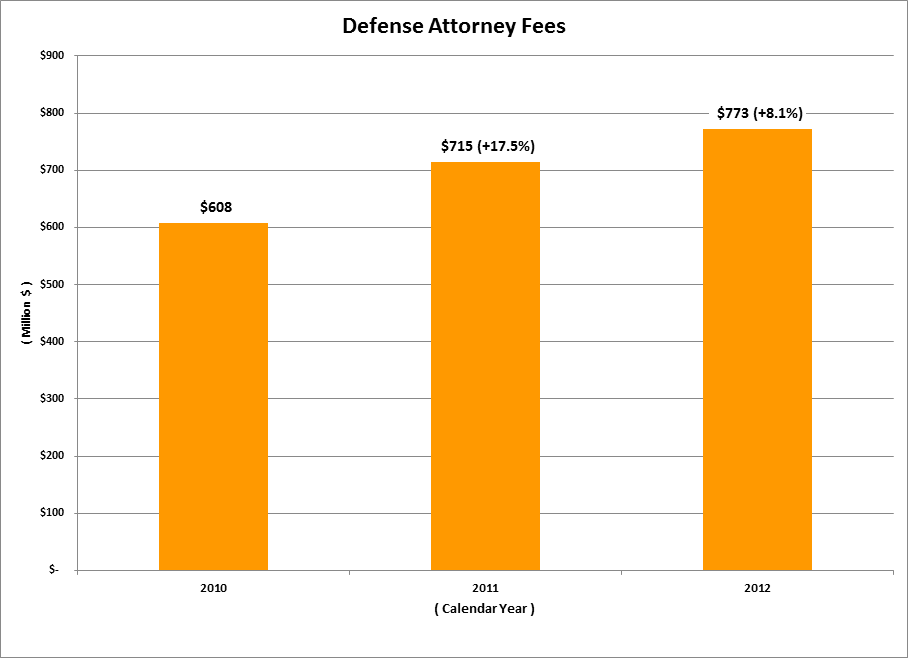
In contrast, the California Workers' Compensation Insurance Rating Bureau last reported gross total attorney fees in California for 2012 was about $1.223 billion. Applicant attorneys got $450 million of that gross, and the defense was paid about $773 million.

Fees in California have been growing at about 8 % per year since just a couple years after Schwarzenegger's SB 899 sharply curtailed the benefits upon which most applicant attorney fees are based.
image002.png
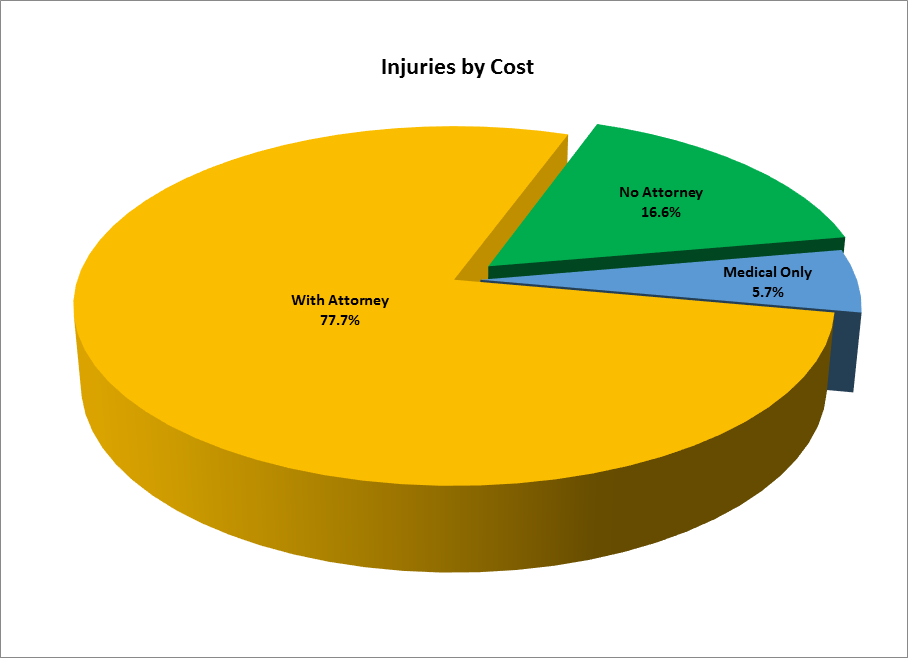
Indemnity claims in CA with an attorney are 78% of all claim costs. 

I was curious about how California stacked up against Florida - both states are known for being particularly litigious in workers' compensation.

A walk around the exhibit floor at the annual Workers' Compensation Institutes conference in August impresses one with all of the defense firm exhibits (and parties).

California lawyers on the other hand each have their own conferences, and even still defense firms will exhibit at some of the other employer or carrier based conferences in the state.
image003.png
In contrast to FL, CA defense fees have continued to grow.

So while this is not a scientific study, and in fact I'm not even comparing apples to apples because the dates of the data collection are different, and there are other serious issues with this analysis that any competent high school statistician could tear apart, it is interesting nevertheless in terms of seeing where a big part of the money goes.

One comparison is just how big of a market are we really talking about.

For instance, California's gross written premium for 2013 according to the WCIRB was about $14.8 billion; the national gross written premium according to the National Council on Compensation Insurance was about $41.9 billion (includes state funds and private carriers).

So California represents about 35% of the total gross written premium of the entire nation.

According to NCCI's last report Florida's total gross written premium for 2013 is $3.21 billion, or 7.7% of national gross.

If we compare attorney fees as reported above to gross written premium, then for every premium dollar collected in California, twelve cents went to attorneys.

In Florida that ratio is 8.4 cents; a difference of about 30%. In other words, if you're going to be a lawyer in workers' compensation, California is about thirty percent more lucrative than Florida.

If we compare how much goes to defense representation as opposed to injured worker representation, the ratio is very close.

In California the ratio is 1.72. In other words for every applicant attorney dollar the defense spent a dollar and seventy two cents.

In Florida the ratio is 1.69; a very similar ratio.

Defense attorneys will defend (pun intended) their fees because work comp is "long tail" so they are working on cases that may be years old, or that they need to deal with issues that claimants don't such as resolving unsettled medical expenses.

Whatever - the point is that there is a lot of work available for attorneys, particularly defense attorneys, in workers' compensation. Just look at WorkCompCentral's job ads!

Sometimes I wonder if I should have stayed the course and remained a defense attorney instead of founding WorkCompCentral.

Nah....

Wednesday, October 8, 2014

Fruit Dynamics Revisited

In July I opined that an arrest of 105 undocumented workers at a fruit packing plant in Florida, without also citing the employer where there is strong evidence that it too engaged in immigration fraud, was, "lightly veiled discrimination based on race. The masters aren't prosecuted for their fraud and deceit, but the powerless workers are punished for their enslavement."

This morning it was reported that the undocumented workers arrested in that raid have been given "diversion" which would allow the charges to be dropped assuming compliance by the accused.

It was also reported that an investigation into the employer is still ongoing.

The July 16 raid on Fruit Dynamics resulted in the 105 workers being charged with using counterfeit or fictitious personal information to obtain employment and using false identity information for the purposes of filing a workers’ compensation claim.

The vast majority of the arrested workers reportedly never filed a workers’ compensation claim, prompting criticism that the state was using workers’ compensation law as a tool for immigration enforcement.

Florida Statute 440.105(4)(b)(9) holds that it’s unlawful to “knowingly present or cause to be presented any false, fraudulent, or misleading oral or written statement to any person as evidence of identity for the purpose of obtaining employment or filing or supporting a claim for workers’ compensation benefits.”

Investigators from the Florida Division of Insurance Fraud and the Collier County Sheriff’s Department executed the July raid. Florida Chief Financial Officer Jeff Atwater said in a release at the time that the lead the investigators were following would “result in dozens of workers’ compensation arrests and many arrests for identity theft that have been potentially devastating for victims.”

It doesn't seem like that is the case after all.
But they KNEW Bowzer was undocumented...
The fact is that the few workers' compensation cases that were in process by workers injured at the Fruit Dynamics plant in Naples, FL resulted in termination of the workers - the employer clearly was sending a message to its undocumented workers: don't file a claim for injury.

Clearly the employer threatened, and executed, retaliatory action in order to keep its undocumented workforce complicit, and quiet.

Though frankly the charges against the workers arrested in my mind should just be dropped, at least the diversion program is the next best thing, except that now these poor folks also have to cough up $50 per month for the administrative cost of the program - and we know that these are people at the lowest rung of the economic ladder. $50 is meaningful to them...

According to this morning's report, though, Fruit Dynamics is also under investigation.

Ashley Carr, deputy director of communications for the Department of Financial Services, said Tuesday that “several allegations remain against the company” and that the investigation into those allegations was continuing, though she would not elaborate further.

The allegations against the company presently appear focused on misreported payroll. An October 2013 audit by Fruit Dynamics’ workers’ compensation carrier showed the company was underreporting its payroll. Guarantee Insurance Co.’s workers’ compensation policy covered 102 employees, but the plant employed an average of 165 employees five days a week according to documents filed in the case.

But attorneys and others representing the arrested workers say that the company knew it was hiring undocumented workers and used that fact as clubs against the workers to ensure their complicity and quietude.

This is more than payroll fraud. It is a case of racial discrimination bordering on enslavement.

Claimants’ attorney Michael Winer, president of Florida Workers’ Advocates, said, "to prosecute anybody under the banner of workers’ compensation fraud, when that person has never had a workers’ compensation accident, just fundamentally to me seems to be wrong.”

It's not just wrong, it's abuse, intolerance and bigotry under the color of law - and that is unforgivable in 2014.

Thursday, August 14, 2014

Padgett is About Bigger Issues

Starting this Sunday thousands of people from the workers' compensation industry descend upon Orlando, FL. for the bacchanal otherwise known as the 69th Workers' Compensation Educational Conference.

I am on several panels at this event, but I suspect that, since the event is Florida based, one of the hottest topics is going to be yesterday's ruling by Miami-Dade Circuit Judge Jorge Cueto in Padgett vs. State of Florida, that the exclusive remedy provision of Section 440.11 is facially unconstitutional.

That a trial level judge would take the time and energy to write a 20 page opinion denigrating an entire legal operating system and throwing the door wide open for challenges is extraordinary. The fact that Judge Cueto even took an interest in workers' compensation is beyond extraordinary.

And knowing that the only resolution of such a conflicting issue is an appeal to the Third Circuit or directly to the FL Supreme Court is pure judicial chutzpah.

The basis for Judge Cueto's ruling is that over the years the Florida workers' compensation act's original grant of benefits for permanent disability, which was part of the "Grand Bargain," has been so eroded as to no longer serve as an adequate remedy.

Citing the original constitutional test of the exclusive remedy of workers' compensation in the United States Supreme Court case of New York Central Railroad v. White, 243 US 188 (1917), a case in which ironically the business community sought to declare compulsory workers' compensation laws unconstitutional, Cueto quotes one of the more powerful passages in that case:
Bowzer asks, "what is it?"

"One of the grounds of its concern (the workers' compensation act in question) with the continued life and earning power of the individual is its interest in the prevention of pauperism, with its concomitants of vice and crime."

For years attorneys representing injured workers throughout the nation have been saying that the compensation bargain has been eroded and one need only visit all of the various injured worker "forums" on the Internet to see that this particular demographic feels pushed into pauperism as a consequence of industrial injury.

Cueto is basically saying that if the remedy provided by the Florida Act is mandatory and exclusive, then it doesn't meet constitutional muster because there isn't enough money to keep injured workers from diving into pauperism, which harms all of society and places excessive burdens on other systems such as Social Security or Medicare (or what we like to call in our sanitized jargon "cost shifting").

Cueto teed up the ball and drove it way down the fairway with his analysis. He said that while the exclusive remedy provision has been part of Florida's Workers' Compensation Act since 1935, it wasn't exactly "exclusive" until 1970, when lawmakers eliminated the ability of employers to "opt-out" of participating in the comp system.

At that time, Cueto said, the "benefits provided by the act should have increased substantially to account for the change in the value of the trade; i.e., allegedly fast, sure and adequate payments in exchange for the tort remedy that was cumbersome, slow, costly and under which it had been legally difficult for injured workers to prevail."

Lawmakers again tinkered with the act in 2003, to eliminate the payment of any compensation for a permanent loss of wage-earning capacity that is not total in character, Cueto noted. And even if the loss is total, the act cuts off benefits once the worker hits 75 or after receiving benefits for five years.

The amended version of the act also apportioned medical care expenses for workers between an employer and the worker, and if the worker can't afford his share of the cost, then the worker can't get treated, Cueto said.

Cueto reasoned that if the Act would "provide full medical care and some compensation for total or partial disability, it remains constitutional." But as it now stands, Cueto said, "it is inadequate as an exclusive replacement remedy for all injured workers."

Chief Workers' Compensation Judge David Langham in his blog post this morning asks, "What IS IT?" In other words, what does this court decision mean to the rest of the workers' compensation world?

While there will be plenty of debate about procedure, where the appeal is going to be first heard, and how the various special interests are going to line up, this is what I take out of Cueto's ruling: the adequacy of benefits in workers' compensation is getting the attention of the judicial system from coast to coast.

In California the constitutionality of the state's system is being picked at piece by piece with the Angelotti case challenging changes to the lien system, and other cases taking on SB 863 provisions.

Last year the Texas Office of Injured Employees Counsel released a couple of reports suggesting the dispute resolution system lacked constitutional protections for injured workers.

There are other states where workers' compensation laws are being questioned as conforming to the original bargain in one form or another.

Plenty of speculation will be circulating this coming week and surely this case will be the center of debate at next week's conference.

Cueto's ruling opens the debate full fledged however and is the boldest trial level attack on the system I can ever remember. Even Florida's Westphal case about attorney fee caps lacks the sheer boldness of Padgett.

What's really going on around the country, with Oklahoma opt out, constitutional attacks, complaints about costs and inadequate benefits is a debate that I've been having for quite some time: Is workers' compensation even relevant any longer?

It seems to me this debate is getting louder and, as work comp is a microcosm of society, points to larger issues facing society - a huge discord between the minority of "haves" versus the vast majority of "have nots."

Cueto in the Padgett case is really opening up a debate about whether society is taking care of its own any longer.

The Padgett case is about social unrest. We are, indeed, meandering into challenging times where the nation's soul is being examined.

Thursday, July 31, 2014

How Dare They

Last week WorkCompCentral reported on a raid in Florida of a company, Fruit Dynamics, arresting over a hundred undocumented workers.

Investigators from the Florida Division of Insurance Fraud and the Collier County, Florida, Sheriff's Department arrested workers from Guatemala, Mexico, Honduras and El Salvador.

Florida Chief Financial Officer Jeff Atwater, who runs the division, called the arrests "workers' compensation fraud" even though only a few of the workers had filed injury claims. The arrests were made under Florida Statutes Chapter 440, the workers' compensation law, which makes it a third-degree felony to use false documents to obtain employment or file an injury claim.

Maj. Geoffrey Branch of the Division of Insurance Fraud told Fox News Channel 4 the week of the story that the owners are not suspected of any complicity in the fraud.

"At this time, we do not believe anybody affiliated with the ownership or management had any idea that any of these documents were fraudulent," Branch said, according to the Fox 4 report. "We believe that they thought they were on their face value valid, authentic documents."

In fact the reason for the raid in the first place was because the original complaint was against the employer for intentionally hiring undocumented workers in a pattern of behavior and practice to underreport payroll and intimidate workers out of benefits for work injuries.

An attorney that represented several injured workers at the plant over the years had made the complaint to the Division because there was a pattern of practice he noted - that the employer's hiring and management practices were intentionally done to minimize workers' compensation liabilities and abuse immigrant workers.

So 105 workers get arrested for immigration and documentation fraud under a workers' compensation statute, even though most did not file any injury claims, and the employer faces no retribution whatsoever from the law even though there is documented evidence that the company knew what it was doing and its insurance carrier went along with the plan in complicity.
Bowzer persecuted because his face is brown

According to an affidavit signed by Lt. Mark Fritz, a state insurance investigator, the case started with a complaint made by Wellington, Florida, attorney Michael Elstein last September.

Elstein warned "there are numerous unauthorized workers (from another country) who are employed at Fruit Dynamics." He said the company also operated as Incredible Fresh and Collier County Produce.

Fritz said Elstein told investigators that the employer knew the workers were unauthorized. He reported in the affidavit that Elstein represented clients who had filed workers' compensation claim. He identified Elstein as a "defense attorney," apparently not understanding workers' comp industry parlance.

"Defense Attorney Elstein reported that when an employee became injured, he/she was terminated most of the time and/or harassed," Fritz wrote in the affidavit. "The insurance carriers in turn would then attempt to suspend his/her benefits and claim he/she committed fraud by using a false Social Security number in connection with their workers' compensation claims."

Elstein told WorkCompCentral, "I got so tired of this particular employer. Over the past five or six years I'd represented at least 10 of their workers, and I decided I had to find a way put an end to this."

Elstein had the permission of his clients to make the initial report, but the investigators from the Division of Insurance Fraud didn't then, and haven't yet, pursued the employer even though there is overwhelming documentation filed along with the criminal affidavits that not only did the employer know what it was doing, but it's insurance company knew too.

In his affidavit, Fritz alleged that the company's workers' compensation carrier, Guarantee Insurance Co., showed Fruit Dynamics was underreporting its payroll and thereby reducing its premiums by nearly half.

Of 212 Fruit Dynamic workers checked by the Division of Insurance Fraud, investigators identified 171 workers who used a stolen Social Security number or another person's identity to seek and maintain employment at the company.

And yet, no charges against the company or its managers and owners?

This is the double standard that can not be tolerated. Say what you will about whether or not undocumented workers are deleterious or beneficial to the economy, the bottom line is that unscrupulous employers will take advantage of them if they think there is a financial advantage to do so.

That any state would seek to bar workers' compensation benefits to undocumented workers is just plain backwards thinking - fortunately some lawmakers in North Carolina, where just such an attempt was made this legislative session, are smart enough to know that, killing such language in House Bill 369 in committee.

WorkCompCentral columnist Peter Rousmaniere wrote last month that based on extrapolation of statistics, undocumented workers sustain one out of every 10 work injuries.

"This high volume is invisible to almost everyone except for adjusters, case managers, lawyers and others who work directly with injured workers and have learned their work and life patterns," Rousmaniere wrote.

Rousmaniere concludes, "James Baldwin, debating William Buckley at Cambridge University in 1965, described the legacy of slavery as the tragedy 'when one has absolute power over another person.' To the undocumented worker, her or his employer holds nearly absolute power over safety. A work injury could result in jail time and deportation. Neither the workers' compensation system or worksite safety are healthy when one tenth of injured workers are in a constant state of vulnerability."

This double standard must stop. It is lightly veiled discrimination based on race. The masters aren't prosecuted for their fraud and deceit, but the powerless workers are punished for their enslavement.

I thank people like Elstein who stand up for immigrants and their rights.

And the people of our government who are complicit in employer fraud should be taken to task: Atwater should be removed from office, state investigators and prosecutors who turn the blind eye should be fired.

How dare they abuse the confidence of The People.

In terms of racial equality, this country, unfortunately, has a very, very long way to go.

Tuesday, July 29, 2014

Is It Fair and Reasonable?

"In short, denying same-sex couples access to death benefits under the workers’ compensation statute does not bear a fair and substantial relationship to the purposes of the act as identified in Ranney," the Supreme Court of Alaska said in an opinion this week concerning the provision of death benefits to the same-sex partner of a woman who was murdered at her workplace in 2011 even though they weren't married.

In 2005 the court rejected an award to an opposite-sex couple that was not married in Ranney v. Whitewater Engineering.

In this most recent case, Harris v. Millennium Hotel, the court pointed out that opposite-sex couples are permitted to marry under Alaska law, but same-sex couples are not.

Section 25.05.013 of Alaska’s statutes provides that “a same-sex relationship may not be recognized by the state as being entitled to the benefits of marriage.” But, the Supreme Court pulled from precedent opinions that said that the state’s workers’ compensation act used marriage as “an adequate proxy for the more particularized inquiry concerning whether a relationship is serious enough or a partner is sufficiently dependent to justify awarding benefits.”

Because same-sex couples have no access to that proxy, the court ruled that such an individualized inquiry would be needed in cases involving death benefits.

Of course there are going to be critics who will claim such rulings unnecessarily increase the costs of workers' compensation, but the court seemed to weigh that in its analysis as to "fair and substantial relationship," noting the minority statistics of the affected population.
Bowzer's neither fair nor reasonable...
Looking at the broader scope of a state supreme court taking on the most elemental characteristics of a workers' compensation act, a complete fabrication of political contrivance, Alaska's justices have focused on a significant inquiry.

Forget about gay rights - this case isn't about that in my opinion. Whether execution of the state's workers' compensation act bears a "fair and substantial relationship" to the purposes of that act is a BIG question and goes way beyond gay rights.

Yesterday I noted that a few Florida cases were challenging that state's workers' compensation statutes on the grounds that over time, due to many changes in the law, the constitutionality of 440.11 (Florida's work comp title) has eroded.

The same basic argument, albeit in a more legal context, is being made there, 3800 flight miles away: whether operation of Florida's workers' compensation laws bear a fair and substantial relationship to the purposes of that act.

Obviously the plaintiffs in the Florida cases argue that it no longer does.

And the opponents to those Florida suits are going to argue that costs have to be kept in check, and that the legislature has done so with surgical excision of unnecessary components.

While Alaska's justices are not questioning the overall constitutionality of that state's system, they have in one very small part essentially said that it can not meet constitutional analysis.

Most state's workers' compensation acts have as a foundation the state constitution.

The state constitution defines, in a very broad sense, the social obligation.

The Supreme Court in Harris said that obligation is, “to ensure the quick, efficient, fair and predictable delivery of indemnity and medical benefits to injured workers at a reasonable cost to employers,” nearly identical to how I defined it yesterday.

Ask most employer representatives and they'll tell you that the laws fail their part of the bargain - reasonable cost.

And ask most employee representatives and they'll also say the system fails to deliver quick and predictable medical and income benefits.

If both constituencies are correct, then whatever legislative alterations has caused those failures to occur might be challenged along the Alaska Supreme Court's reasoning.

Are we moving into a new era in work comp? I can't tell that, but when both business and labor complain that they are failing to realize any value and that realization is translated into legal challenges, then inquiries into fair and reasonable relations (a subjective standard) get made...

Wednesday, June 4, 2014

Comunicación No Es Médicamente Necesario

Immigration has been the root of America's economic growth and with immigration comes diversity.

Diversity is experienced in race, religion, culture and language, among other criteria.

In the sixties diversity was defined by skin color and that ultimately spawned the Civil Rights Act to deal with the adverse consequence of diversity: discrimination.

Over the past 50 years population diversity has changed character. While discrimination is still a reprehensible reality, there have been some significant advances in race relations, religious tolerance and acceptance of sexual preferences.

One element that has always defined acceptance as an American, though, has been language.

While English is the preferred language of America, the 1980s introduced an unofficial second language - Spanish.

As immigrant rights continued to expand and be recognized, along with the huge economic market represented by the Hispanic population, governments and then businesses began interpretive communications.

Public and private signs in both English and Spanish are common place. Nearly all instructions for whatever good you might buy are in both languages (sometimes more). Governmental publications are published in English and Spanish and it seems most second generation Americans are bilingual.

There are still friction points though, and a recent Florida workers' compensation case about entitlement to bilingual treatment demonstrates the diversity of opinion on the subject.

In 2012 Jesus Trejo-Perez suffered a closed head injury when he fell 30 to 40 feet from a ladder. His employer, Arry's Roofing, accepted the injury as compensable and authorized treatment from several doctors, including Dr. Angelo Alves, a neurologist.

Alves recommended that Trejo-Perez undergo a neuropsychological evaluation for his memory, cognition and emotional state. Arry's then set an appointment with Dr. Arthur J. Forman. Since Forman did not speak Spanish, and Trejo-Perez's spoke only limited English, Arry's made an interpreter available for Trejo-Perez's office visits.

Trejo-Perez objected to this arrangement and filed a petition for benefits, seeking authorization for an evaluation by a Spanish-speaking neuropsychologist. He explained that he "didn't want to do it through an interpreter" because he didn't want to talk about the intimate details of his life through another person.

Alves supported his claim, testifying that Trejo-Perez "needs to have a neuropsychological evaluation done by a Spanish speaking-psychologist." He explained that having the evaluation done through an evaluator is "not the same," because the doctor "could get the wrong information."

The Judge of Compensation Claims wasn't persuaded. He said that, "Dr. Alves' insistence on a Spanish-speaking psychiatrist and neuropsychologist is based solely on the possibility that one 'could get the wrong information'" and this "does not equate to medical necessity."

Trejo-Perez appealed but a split panel of the First District Court of Appeals, which has original and exclusive appellate jurisdiction over workers' compensation appeals, agreed with the JCC.

The court found that while a Spanish speaking provider would be preferred, the evidence did not establish medical necessity.

In a concurring opinion Judge Makar addressed the challenges of meeting health care expectations within the limited resources of any health care delivery system.

"In an ideal world with unlimited resources," he said, "patients would have health care information published in their own primary languages, and their health care service providers would speak their primary languages." But since this ideal is "unattainable," Makar noted that "the trajectory of the language access movement in the United States currently has gravitated to the use of translators (for written communication) and interpreters."

Makar said there was no evidence as to whether use of a linguistically-compatible interpreter is incompatible with prevailing practice parameters in the provision of health care services generally or psychiatric services specifically. Likewise, the record had no evidence on whether the field of psychiatry has adopted − as a widely accepted practice − a requirement that patients are entitled to a primary language-speaking psychiatrist.

The dissent by Judge Bradford L. Thomas argued that no medical testimony supported the JCC's view that the Spanish-speaking psychiatric evaluation was NOT medically necessary, and that the JCC had failed to give any "reason" for rejecting Alves' opinion.

With regard to the dissent by Judge Thomas, it seems to me that he has the burden of proof backwards, and he also ignores the substantial evidence standard.

However, the majority opinion seems to take the position that Spanish is a "minority" language - and it isn't.

Demographic research shows that the Hispanic population has outgrown the white population in California and New Mexico, and probably a few other state, and projections are that these demographics will be reflected in the overall United States population by 2040.

California has about 14 million Hispanics out of an overall population of about 33 million, as measured by the Census Bureau, and 47% of New Mexico's population is Hispanic. While the white population is still the majority in Texas, that status is projected to change very soon as Hispanic population growth represents nearly 64% of all population growth since 2000.

In contrast, Florida has 4.5 million Hispanics, representing about 23% of the population. And since workers' compensation is state specific, relative to the overall demographic make up of Florida, the 1st DCA's ruling would make sense.

But as Bob Dylan sang 50 years ago, "the times, they are a changing."

I don't think that can be ignored.

To read the court's decision, click here.